Several bottles on the art-supply shelf still promise the same thing Jan van Eyck’s admirers have been chasing for nearly two hundred years: the true Van Eyck medium, the rediscovered secret of the old masters. An amber-based varnish is marketed as a rediscovered Flemish secret. A dammar-and-linseed medium traces its authority to a 1932 claim about Van Eyck and Rubens. A modern manufacturer’s “Black Oil” is still sold essentially unchanged from a 1940s formula built on the same premise. Each product is a small bet that a specific historical theory about the Van Eyck medium was correct.
Conservation science has since checked that bet. The verdict is not what most of these products imply.
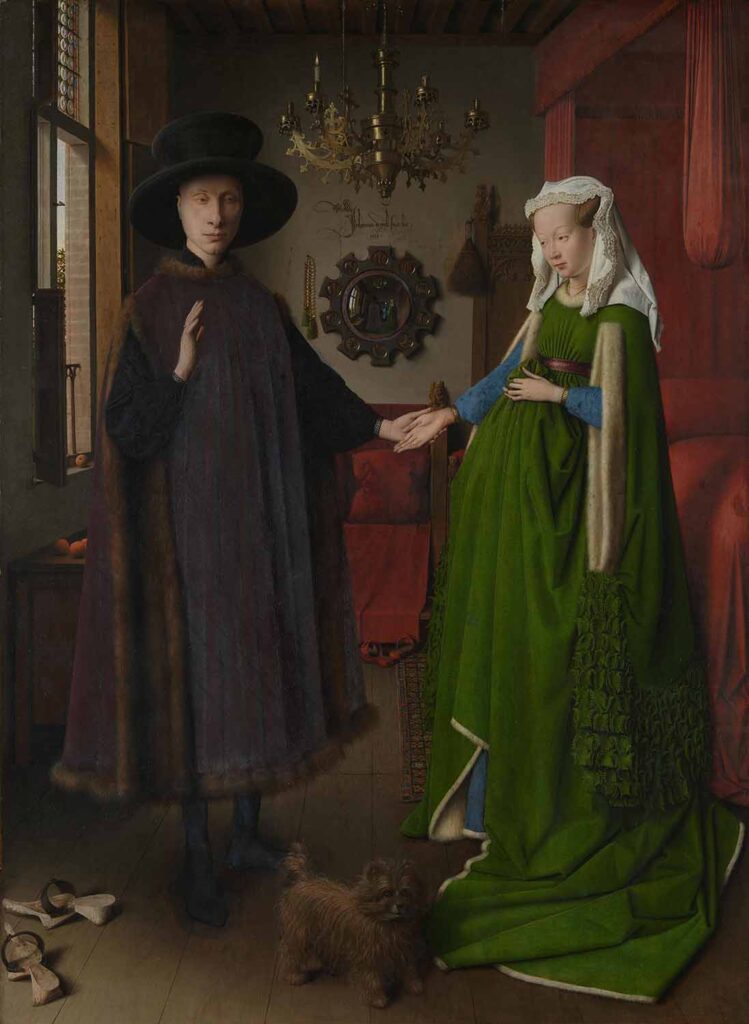
Jan van Eyck, The Arnolfini Portrait, 1434, oil on oak panel, National Gallery, London. This is the painting Charles Eastlake examined firsthand in the 1840s to build his amber-varnish theory, and the same painting Raymond White’s GC/MS analysis tested directly some 150 years later. Look at the brilliance of the fabrics, the convex mirror, and the fine detail in the brass chandelier — this is the effect every “secret medium” theory in this article was trying to explain. Modern analysis found it came from linseed oil alone, applied with exceptional skill, not a hidden ingredient. Public domain; National Gallery, London.
Why This Question Still Matters at the Easel
It would be easy to treat the search for the Van Eyck medium as a historical curiosity, interesting to scholars but irrelevant to a working artist choosing what to put in a medium cup. That would be a mistake. Several commercially available products, some marketed since the nineteenth century and others sold today, base their appeal directly on a claim about how Van Eyck painted. If that claim is wrong, an artist is not just buying a product with a colorful backstory. They are buying a specific set of working properties and aging behaviors, justified by a historical argument that modern instrumental analysis does not support.
This article traces that argument from its origin to its resolution. It uses a 2006 historiographic review by conservator Elise Effmann as its backbone (Effmann 2006). Effmann’s paper does not report new laboratory findings of its own. Instead, it does something more useful for this purpose. It lays out, in sequence, exactly how two centuries of confident theorizing about Van Eyck’s medium rose, fell, and was eventually replaced by instrumental evidence, closing with a concise account of what that evidence actually shows. Read carefully, that sequence is a case study in how “secret recipe” claims get made, get believed, and eventually get tested.
A companion piece on the Natural Pigments site has already traced the broader cultural history of this obsession in detail. It runs from Joshua Reynolds’s disastrous experiments with megilp through Eastlake and into the twentieth century. This article does not repeat that ground. Instead, it uses Van Eyck specifically as the test case. It spends most of its attention on the modern scientific resolution that the cultural history could only gesture toward. Then it asks a narrower, more practical question: given what conservation science actually found, what should an artist make of the products still sold on the strength of the older theories?
The Core Question, in One Sentence
For nearly two centuries, respected authorities gave confident, mutually contradictory answers to a simple question about the Van Eyck medium: what did Jan van Eyck actually mix his paint with? Direct instrumental analysis of his paintings, completed only in the last several decades, finally resolved the question. The answer turned out to be much simpler than almost anyone had proposed.
Want to read the full article and unlock all resources? Choose an option below:
Munsell notation for painters explained: what hue, value, and chroma actually promise, how Richard Murdock and Graydon Parrish mix toward it, and where it falls short.
Painting on wood panels? Learn how plywood, MDO, and HDO boards serve as durable supports. This guide covers stability, surface prep, pros & cons, and best practices for oil, acrylic, and tempera.
When I was a younger man, I didn’t stop searching for the Van Eyck”s secret. It’s only in my older days that painted a copy of this painting. I think I missed the secret. But watch for yourself.
Please note:
This action will also remove this member from your connections and send a report to the site admin.
Please allow a few minutes for this process to complete.
Report
You have already reported this .
Cookie Consent
We use cookies to improve your experience on our site. By using our site, you consent to cookies.
Cookie Preferences
Manage your cookie preferences below:
Essential cookies enable basic functions and are necessary for the proper function of the website.
Name
Description
Duration
Cookie Preferences
This cookie is used to store the user's cookie consent preferences.
30 days
These cookies are needed for adding comments on this website.
Name
Description
Duration
comment_author
Used to track the user across multiple sessions.
Session
comment_author_email
Used to track the user across multiple sessions.
Session
comment_author_url
Used to track the user across multiple sessions.
Session
WooCommerce is a customizable eCommerce platform for building online stores using WordPress.
Name
Description
Duration
woocommerce_snooze_suggestions__
Allows dashboard users to dismiss Marketplace suggestions, if enabled.
2 days
woocommerce_dismissed_suggestions__
Count of suggestion dismissals, if enabled.
1 month
woocommerce_cart_hash
Helps WooCommerce determine when cart contents/data changes.
session
woocommerce_items_in_cart
Helps WooCommerce determine when cart contents/data changes.
session
wp_woocommerce_session_
Contains a unique code for each customer so that it knows where to find the cart data in the database for each customer.
2 days
woocommerce_recently_viewed
Powers the Recent Viewed Products widget
session
store_notice
Allows customers to dismiss the Store Notice.
session
Statistics cookies collect information anonymously. This information helps us understand how visitors use our website.
Facebook Pixel is a web analytics service that tracks and reports website traffic.
ID used to identify users for 24 hours after last activity
24 hours
_gat
Used to monitor number of Google Analytics server requests when using Google Tag Manager
1 minute
__utmc
Used only with old Urchin versions of Google Analytics and not with GA.js. Was used to distinguish between new sessions and visits at the end of a session.
End of session (browser)
__utmz
Contains information about the traffic source or campaign that directed user to the website. The cookie is set when the GA.js javascript is loaded and updated when data is sent to the Google Anaytics server
6 months after last activity
__utmv
Contains custom information set by the web developer via the _setCustomVar method in Google Analytics. This cookie is updated every time new data is sent to the Google Analytics server.
2 years after last activity
__utmx
Used to determine whether a user is included in an A / B or Multivariate test.
18 months
_ga
ID used to identify users
2 years
_gali
Used by Google Analytics to determine which links on a page are being clicked
30 seconds
_ga_
ID used to identify users
2 years
_gac_
Contains information related to marketing campaigns of the user. These are shared with Google AdWords / Google Ads when the Google Ads and Google Analytics accounts are linked together.
90 days
__utma
ID used to identify users and sessions
2 years after last activity
__utmt
Used to monitor number of Google Analytics server requests
10 minutes
__utmb
Used to distinguish new sessions and visits. This cookie is set when the GA.js javascript library is loaded and there is no existing __utmb cookie. The cookie is updated every time data is sent to the Google Analytics server.
30 minutes after last activity
Marketing cookies are used to follow visitors to websites. The intention is to show ads that are relevant and engaging to the individual user.
Name
Description
Duration
affwp_ref
Stores the referring affiliate ID for commission attribution.
30 days
affwp_ref_visit_id
Stores the visit ID linked to the referring affiliate.
30 days
affwp_campaign
Stores the affiliate campaign name for tracking purposes.


When I was a younger man, I didn’t stop searching for the Van Eyck”s secret. It’s only in my older days that painted a copy of this painting. I think I missed the secret. But watch for yourself.
https://www.kunstwerkt.be/nl/werken/mark-van-crombrugge/arnolfini-portrait-arnolfini-portret-replica