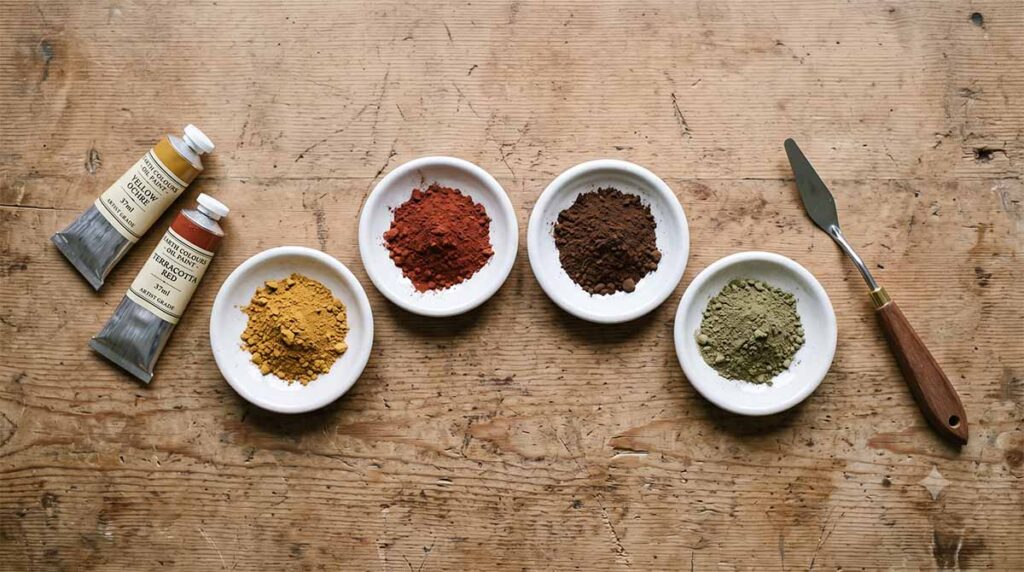
Natural earth pigments — yellow ochre, raw sienna, burnt sienna, terra rosa, terre verte — have been on the artist’s palette since the Paleolithic. The names have persisted. What is actually in the tube has not.
The Colour Index designation printed on the back of nearly every professional oil paint tube is a small code — two letters and two or three digits — that identifies the actual pigment chemistry inside. It sits beside the ingredient statement, usually smaller than the price sticker. Most painters have never looked at it, and manufacturers do not go out of their way to draw attention to it.
That small code is where the gap between what a tube is called and what a tube contains gets settled. A tube labeled Yellow Ochre whose code reads PY 43 contains mined natural goethite — the same mineral pigment used in the Lascaux caves. A tube with the same Yellow Ochre label but a code that reads PY 42 contains synthetic hydrated iron oxide, precipitated in a factory to specifications the natural mineral cannot consistently meet. Both are legitimate pigments. Neither has been mislabeled. The two tubes will not behave the same way in oil, and the painter who thinks they will has been misled — not by any manufacturer, but by the assumption that a color name is a composition guarantee.
This article is about the gap between those two pieces of information. It is not an article about fraud, and nothing in it suggests that any manufacturer is doing anything wrong. Notably, regulators do not police the pigment and paint industries on the basis of geological provenance. No rule anywhere prevents a manufacturer from calling a tube “Yellow Ochre” when its contents are synthetic, or from selling a dry pigment under the name “Green Earth” when its color comes from a phthalocyanine blend. Similarly, no rule requires the manufacturer to disclose any of this in plain language. The information is on the label — but it sits inside the Colour Index designation, and the reader has to know how to read it.
That matters to artists for a reason that has very little to do with names and everything to do with how paint behaves at the easel.
A Color Name Is a Category Claim. A Colour Index Code Is a Composition Claim.
The tradition of naming pigments after their historical geological sources — ochre, sienna, umber, terre verte — predates modern chemistry by many centuries. These are geographic-and-mineralogical labels. Sienna is the pigment mined from the deposits around Siena in Tuscany. Umber takes its name from Umbria in central Italy. Terre verte is the green earth traditionally mined near Verona. Ochre is the general European term for iron-oxide-and-clay pigments dug from surface deposits across the continent. When pigment manufacturing industrialized in the nineteenth and twentieth centuries, the traditional names carried forward into the modern paint market. The underlying materials often did not. What survived was the color character. The geological source did not.





Responses