The discovery and use of distilled turpentine in painting predates many historical assumptions about its availability and use. Contrary to the traditional view that distillation techniques became widespread only in the 16th century, evidence now suggests that turpentine was utilized much earlier.
This article summarizes key insights from Alan Phenix’s work, Some Instances in the History of Distilled Oil of Turpentine, the Disappearing Painters’ Material. Phenix challenges the traditional assumption that distilled turpentine became prevalent only in the 16th century, presenting compelling evidence of its earlier use. This revelation reshapes our understanding of historical painting techniques, highlighting a previously unrecognized level of sophistication in the handling of materials by medieval and Renaissance artists.
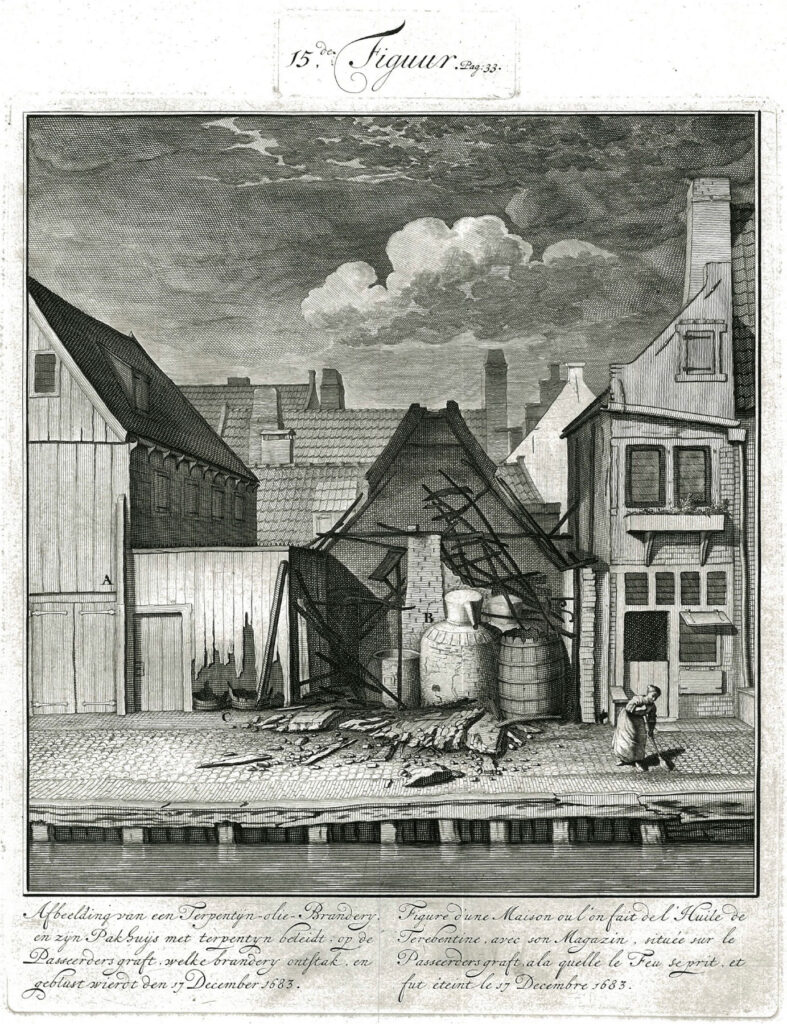
Engraving of a terpentijn-olie branderij on the Passeerdersgracht, Amsterdam, which burned down on 17 December 1683; from the Brandspuiten-boek of Dutch artist and inventor Jan van der Heyden, 1690. (Image from the collection of the author, Alan Phenix)
Early Evidence of Turpentine Usage
The narrative that the distillation of volatile oils such as turpentine emerged only with the advancements of the 16th century is increasingly contested. Historical texts, such as Jean de Saint-Amand’s commentary on the Antidotarium Nicolai, reference oil of turpentine, suggesting its availability as early as the 13th century. This challenges the prevailing view that distilled turpentine was unknown to medieval European painters.
For instance, the manuscript Brussels MS 15624-15641, dating back to the mid-14th century, contains explicit mentions of oil of turpentine being prepared via sublimation. Similarly, the inventories from apothecaries in Marseille and Aix-en-Provence in the early 15th-century list distilled turpentine alongside other medicinal and artistic materials. These records demonstrate a consistent, though sparse, trade and application of turpentine well before the time of Brunschwig’s widely cited distillation treatises of the early 1500s.
Implications for Art Historical Interpretation
The volatility of turpentine means that it evaporates completely over time, leaving no detectable residue in ancient paint layers. This has historically limited the ability to confirm its use through modern analytical techniques. However, understanding its early presence reshapes our interpretation of painting techniques.
The masterful craftsmanship evident in works from the 14th and 15th centuries—particularly the smooth, translucent layers characteristic of Northern European oil painting—might have been facilitated by the controlled use of turpentine. The smoother transitions and delicate glazes achieved by artists like Jan van Eyck could have been aided by these early solvents, which made oil paint more malleable and quicker to dry.
Want to read the full article and unlock all resources? Choose an option below:
Painting on wood panels? Learn how plywood, MDO, and HDO boards serve as durable supports. This guide covers stability, surface prep, pros & cons, and best practices for oil, acrylic, and tempera.
Discover how barite (baryte or blanc fixe) has shaped oil painting from the 18th century to today. Learn its properties, uses, and hidden drawbacks—why it stabilizes paint but can cause brittleness or “chalking” when overused.
This is fascinating, useful information! Perhaps a next article might examine the current trend of substituting oderless paint thinners for distilled turpentine – the implications for paint handling, film strength, longevity, possibility for creating a deodorizer turpentine (!), etc. I certainly miss the feel of traditional turps in my mixtures.
Wonderful article. I still use distilled turpentine, and I find it to be a wonderful solvent for my paints and mediums. I have tried OMS in the past, and for some reason, I cannot use it. It creates sinus pain, and I have an allergic reaction. Distilled turpentine does not affect me this way, especially when I use it moderately.
I learned to paint in England at five years old and with turpentine. I was taught by a couple of the old masters. I am an old gal now, but I am still painting. These days I have difficulty finding turps. Today’s paint thinners are nowhere near the usability and quality of turps. I wish I could find a quality substitute. I have tried them all, but with little success. My old paintings still look great.
Report
There was a problem reporting this post.
Block Member?
Please confirm you want to block this member.
You will no longer be able to:
See blocked member's posts
Mention this member in posts
Invite this member to groups
Message this member
Add this member as a connection
Please note:
This action will also remove this member from your connections and send a report to the site admin.
Please allow a few minutes for this process to complete.
Report
You have already reported this .
Subscribe to Our Newsletter
To begin reading the content, join thousands of artists enjoying our articles. Subscribe to receive updates on artists materials and practices.
This is fascinating, useful information! Perhaps a next article might examine the current trend of substituting oderless paint thinners for distilled turpentine – the implications for paint handling, film strength, longevity, possibility for creating a deodorizer turpentine (!), etc. I certainly miss the feel of traditional turps in my mixtures.
Wonderful article. I still use distilled turpentine, and I find it to be a wonderful solvent for my paints and mediums. I have tried OMS in the past, and for some reason, I cannot use it. It creates sinus pain, and I have an allergic reaction. Distilled turpentine does not affect me this way, especially when I use it moderately.
I learned to paint in England at five years old and with turpentine. I was taught by a couple of the old masters. I am an old gal now, but I am still painting. These days I have difficulty finding turps. Today’s paint thinners are nowhere near the usability and quality of turps. I wish I could find a quality substitute. I have tried them all, but with little success. My old paintings still look great.