Historical and Traditional Uses of Barite in Oil Painting
Barite—known historically as barytes or heavy spar (barium sulfate, BaSO₄)—was one of the earliest non-toxic white minerals incorporated into artists’ paints as a replacement for lead-based pigments. Introduced in the late eighteenth century and increasingly widespread by the early nineteenth century, it became one of the most common extenders in oil colors (Eastaugh et al. 2004). Ground to a fine powder, natural barium sulfate was valued for its chemical inertness, low oil absorption, and permanence in mixtures. Artists’ manuals and manufacturers’ catalogues of the period describe its use not only as a pigment in its own right but also as an ingredient in composite “mixed whites”—notably Venice, Hamburg, and Dutch whites—where lead carbonate was combined with barite in varying proportions to reduce cost and modify handling qualities (Eastaugh et al. 2004). Contemporary accounts praised these mixtures for producing smooth, durable paint films and for barite’s resistance to discoloration or chemical change. By mid-century, its inclusion was so routine that many commercial tube colors contained barite as a filler, even when it was not declared on product labels.
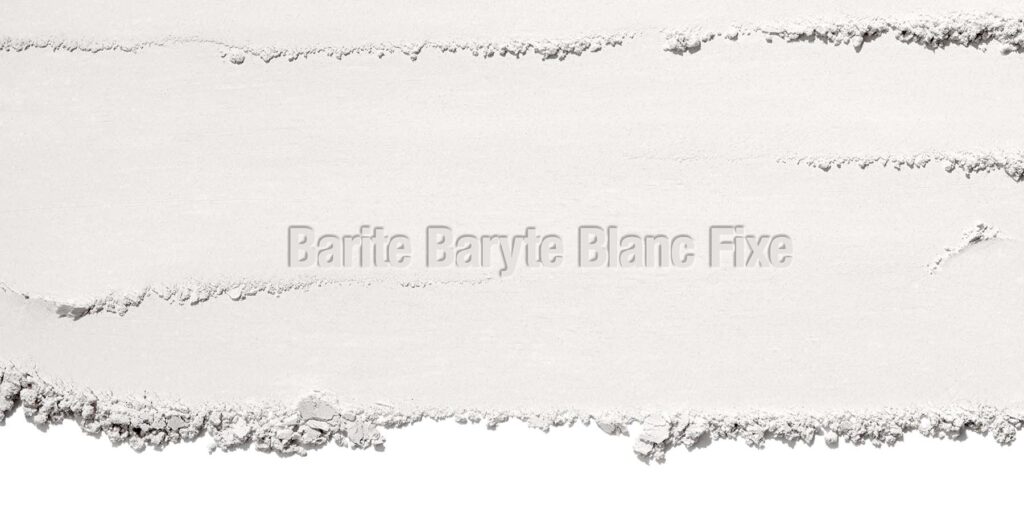
Importantly, barite’s chemically inert nature made it useful as a base for lake pigments (precipitated dyes). The finely divided synthetic form, blanc fixe (“permanent white”), was often used to carry organic colorants in oil paints (CAMEO 2022; Eastaugh et al. 2004). By the 1870s, barite had also been combined with zinc sulfide to produce lithopone, a new white pigment introduced as a replacement for lead white in some applications (CAMEO 2022). In summary, barite became a ubiquitous component in traditional oil painting—present in grounds, mixed whites, and many nineteenth-century tube paints—valued for its low cost, permanence, and filler properties in the era of industrially prepared art materials (Eastaugh et al. 2004).
Barite was also sold as a standalone pigment under names like Permanent White or Constant White in the nineteenth century. However, it never equaled the opacity of lead white. Writers like George Field observed that barite white appeared noticeably less opaque when wet, making it tricky for artists to judge mixtures, and this led to its decline in favor of zinc white by the late nineteenth century (Eastaugh et al. 2004). Importantly, barite’s chemically inert nature made it useful as a base for lake pigments (precipitated dyes): the finely divided synthetic form, blanc fixe (“permanent white”), was often used to carry organic colorants in oil paints (CAMEO 2022; Eastaugh et al. 2004). By the 1870s, barite had also been combined with zinc sulfide to produce lithopone, a new white pigment introduced as a replacement for lead white in some applications (CAMEO 2022). In summary, barite became a ubiquitous component in traditional oil painting—present in grounds, mixed whites, and many nineteenth-century tube paints—valued for its low cost, permanence, and filler properties in the era of industrially prepared art materials (Eastaugh et al. 2004).
Modern Applications and Artistic Use
Barite continues to play a role in modern oil painting as an inert extender and modifier of paint consistency. Many contemporary oil colors (especially student-grade or “mixing white” formulations) include barium sulfate as a filler alongside titanium white or other pigments (Mayer 1991). For instance, one major manufacturer’s “Permanent White” oil paint is a blend of titanium dioxide (TiO₂) with barite, capitalizing on barite’s transparency to reduce the overpowering tinting strength of titanium white (Mayer 1991). Because barite has very low oil absorption and little hiding power, it can be added to oil paint without excessively increasing the paint’s viscosity or requiring much extra oil binder (Eastaugh et al. 2004). This makes it ideal for extending highly saturated or slow-drying pigments. Modern “extender” mediums for oil painters often contain barite (and other fillers such as chalk or silica) dispersed in linseed oil to increase paint volume, transparency, and texture without altering color (Painting Best Practices 2025).
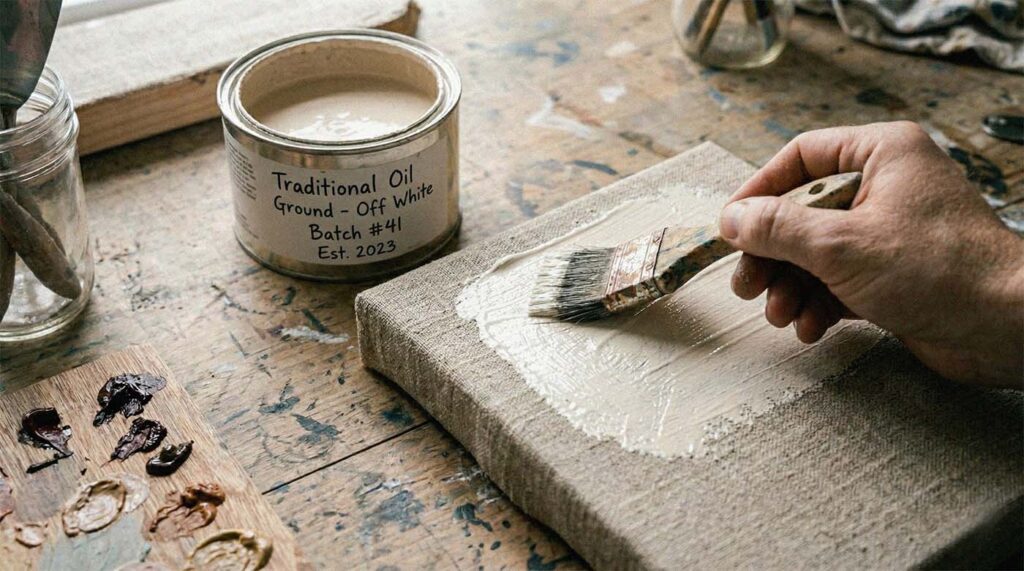
Barite’s use in prepared canvases and primers has diminished compared to the nineteenth century, yet it is still used in some specialty grounds and commercial primers as an inert, heavy filler. Notably, blanc fixe remains a standard filler in the paint, plastics, and paper industries, so artists today encounter it not only in traditional oil paints but also in conservation-grade grounds and even synthetic media. Its legacy persists in products like Permalba White, an artist paint introduced in the mid-twentieth century that advertised itself as a permanent, non-yellowing white, initially using barite for stability. In short, both traditional and modern manufacturers have leveraged barite’s unique qualities: even today, adding barium sulfate is a straightforward way to adjust an oil paint’s opacity, tinting strength, and handling properties while maintaining excellent compatibility with other ingredients (Eastaugh et al. 2004).
Pigment Properties and Visual Qualities
Barite is an inert, transparent white pigment with a refractive index (RI) of around 1.64, only slightly higher than dried oil (≈1.5). This means it confers very low hiding power in oil paint, essentially appearing almost transparent when dispersed in linseed oil (CAMEO 2022). As a result, barite by itself produces a low-opacity, weak-tint white or buff color. Natural barite can even appear off-white or buff due to impurities such as iron oxide, though it was sometimes “bleached” with acid or neutralized with a hint of blue pigment to improve brightness (Eastaugh et al. 2004). Despite its lack of opacity, barite’s physical characteristics make it valuable: it has a high specific gravity (~4.3–4.5 g/mL) and fine, hard particles that impart a desirable weight and consistency to paint (CAMEO 2022).



Responses