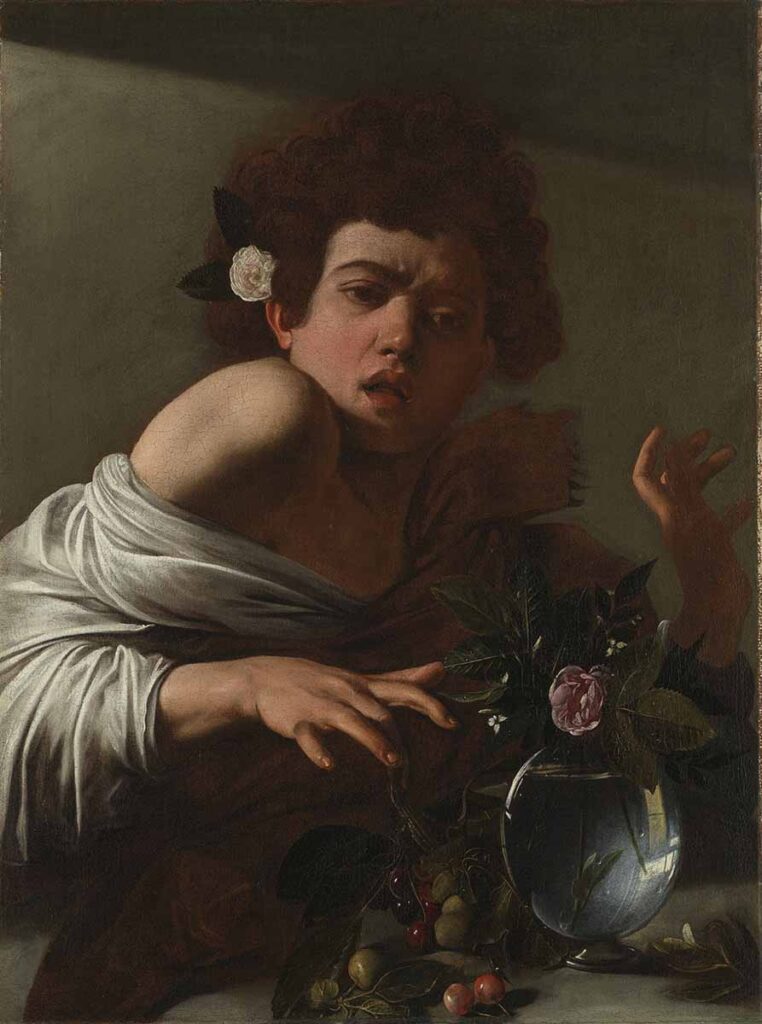
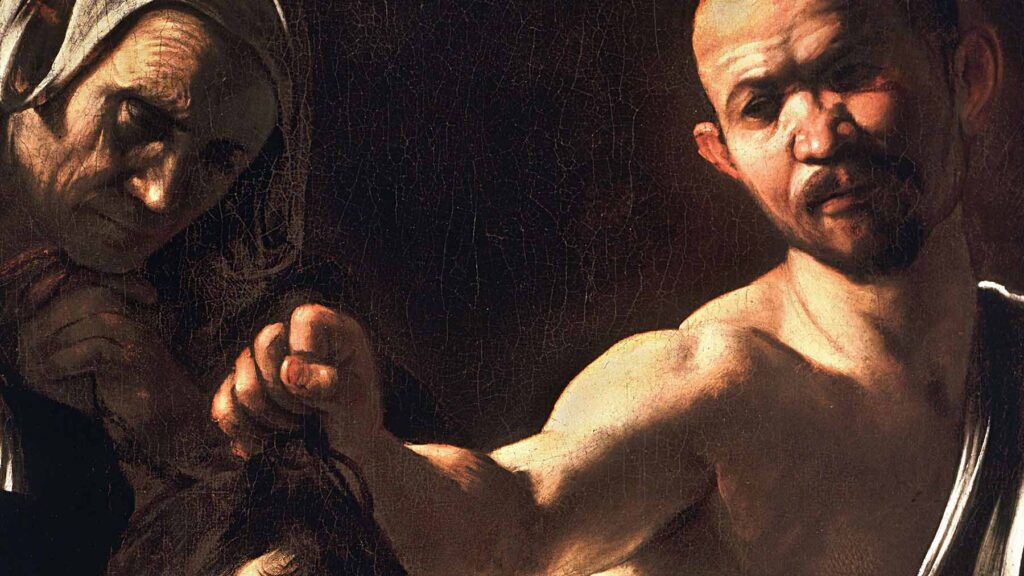
Caravaggio ground technique is the reason his shadows feel bottomless rather than just dark. A 1998 National Gallery study shows exactly how he built that effect into the canvas before he ever picked up a brush. Larry Keith, then a conservator at the National Gallery, London, took cross-sections and X-radiographs from the museum’s three Caravaggios. Together, Boy Bitten by a Lizard, The Supper at Emmaus, and Salome Receives the Head of John the Baptist span nearly his whole career.
What he found upends the tidy idea that Caravaggio simply painted dark. The ground itself was doing real optical work, left exposed and lightly glazed to serve as a ready-made mid-tone across flesh, hair, and drapery.
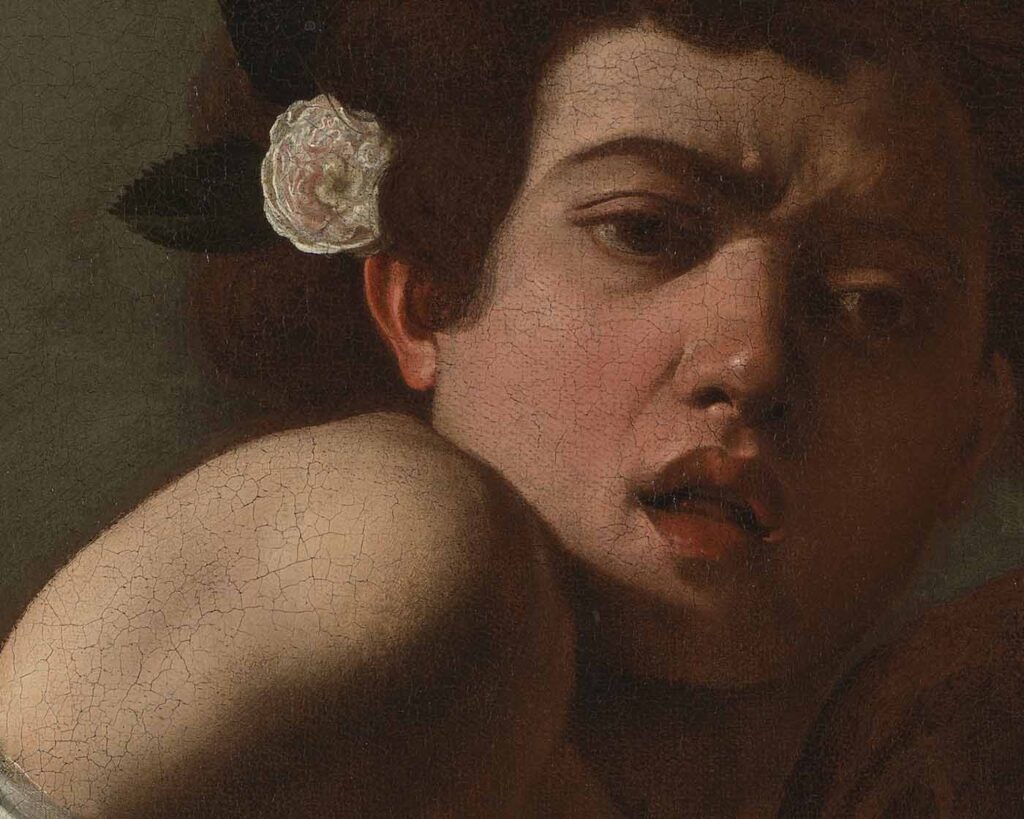
Figure 1. Boy Bitten by a Lizard, the earliest of the three paintings this article discusses. The reddish-brown ground Keith cross-sectioned is visible along the boy’s exposed shoulder and neck.* Caravaggio, Boy Bitten by a Lizard, oil on canvas, c. 1594–96, National Gallery, London (NG6504). 66 × 49.5 cm. Public domain—source: Wikimedia Commons.
Why This Paper Matters
Italian Baroque painting technique has had far less technical study than the Renaissance or Northern European painting of the same period. Caravaggio is the major exception (Keith 1998, 37). Contemporaries already sensed something unusual in his method.
The critic Giovanni Pietro Bellori, writing six decades after Caravaggio’s death, put it in a single memorable line. He was describing a different, later Caravaggio: his 1608 Beheading of Saint John the Baptist, painted in Malta. The line reads, “he left the imprimatura of the canvas for the middle tones” (lasciò in mezze tinte l’imprimatura della tela). Keith cites the line to name the same mechanism he documents directly in Boy Bitten by a Lizard, painted a decade earlier (Keith 1998, 37–38, 39 n. 8).
That’s not a small aside. It means Caravaggio treated the ground as a working layer in the finished painting, not just a surface to cover. Keith’s cross-sections confirm it directly, and go further.
They show which pigments made up that ground, and how thick the paint sits above it in different areas. They also show how Caravaggio’s practice changed, between an early single-figure picture and a late, loosely handled one. For any painter who works on a toned or colored ground today, this is a rare case. You can see the mechanism itself, not just the visual result.
Want to read the full article and unlock all resources? Choose an option below:
Oil paint transparency changes as paint ages. A National Gallery study of three Caravaggios shows how he used opacity and transparency together to build his shadows.
Munsell notation for painters explained: what hue, value, and chroma actually promise, how Richard Murdock and Graydon Parrish mix toward it, and where it falls short.
What happens when your painting ground cracks? New research on gesso fracture toughness, acrylic primers, and zinc white reveals what your ground choice means for longevity.
Caravaggio`s light I am registered to this webinar but I do not know how tu enter. Also I registered two times. pleas lent me know.
Report
There was a problem reporting this post.
Block Member?
Please confirm you want to block this member.
You will no longer be able to:
See blocked member's posts
Mention this member in posts
Invite this member to groups
Message this member
Add this member as a connection
Please note: This action will also remove this member from your connections and send a report to the site admin. Please allow a few minutes for this process to complete.
Report
You have already reported this .
Cookie Consent
We use cookies to improve your experience on our site. By using our site, you consent to cookies.
Cookie Preferences
Manage your cookie preferences below:
Essential cookies enable basic functions and are necessary for the proper function of the website.
Name
Description
Duration
Cookie Preferences
This cookie is used to store the user's cookie consent preferences.
30 days
These cookies are needed for adding comments on this website.
Name
Description
Duration
comment_author
Used to track the user across multiple sessions.
Session
comment_author_email
Used to track the user across multiple sessions.
Session
comment_author_url
Used to track the user across multiple sessions.
Session
WooCommerce is a customizable eCommerce platform for building online stores using WordPress.
Name
Description
Duration
woocommerce_snooze_suggestions__
Allows dashboard users to dismiss Marketplace suggestions, if enabled.
2 days
woocommerce_dismissed_suggestions__
Count of suggestion dismissals, if enabled.
1 month
woocommerce_cart_hash
Helps WooCommerce determine when cart contents/data changes.
session
woocommerce_items_in_cart
Helps WooCommerce determine when cart contents/data changes.
session
wp_woocommerce_session_
Contains a unique code for each customer so that it knows where to find the cart data in the database for each customer.
2 days
woocommerce_recently_viewed
Powers the Recent Viewed Products widget
session
store_notice
Allows customers to dismiss the Store Notice.
session
Statistics cookies collect information anonymously. This information helps us understand how visitors use our website.
Facebook Pixel is a web analytics service that tracks and reports website traffic.
ID used to identify users for 24 hours after last activity
24 hours
_gat
Used to monitor number of Google Analytics server requests when using Google Tag Manager
1 minute
__utmc
Used only with old Urchin versions of Google Analytics and not with GA.js. Was used to distinguish between new sessions and visits at the end of a session.
End of session (browser)
__utmz
Contains information about the traffic source or campaign that directed user to the website. The cookie is set when the GA.js javascript is loaded and updated when data is sent to the Google Anaytics server
6 months after last activity
__utmv
Contains custom information set by the web developer via the _setCustomVar method in Google Analytics. This cookie is updated every time new data is sent to the Google Analytics server.
2 years after last activity
__utmx
Used to determine whether a user is included in an A / B or Multivariate test.
18 months
_ga
ID used to identify users
2 years
_gali
Used by Google Analytics to determine which links on a page are being clicked
30 seconds
_ga_
ID used to identify users
2 years
_gac_
Contains information related to marketing campaigns of the user. These are shared with Google AdWords / Google Ads when the Google Ads and Google Analytics accounts are linked together.
90 days
__utma
ID used to identify users and sessions
2 years after last activity
__utmt
Used to monitor number of Google Analytics server requests
10 minutes
__utmb
Used to distinguish new sessions and visits. This cookie is set when the GA.js javascript library is loaded and there is no existing __utmb cookie. The cookie is updated every time data is sent to the Google Analytics server.
30 minutes after last activity
Marketing cookies are used to follow visitors to websites. The intention is to show ads that are relevant and engaging to the individual user.
Name
Description
Duration
affwp_ref
Stores the referring affiliate ID for commission attribution.
30 days
affwp_ref_visit_id
Stores the visit ID linked to the referring affiliate.
30 days
affwp_campaign
Stores the affiliate campaign name for tracking purposes.




Caravaggio`s light I am registered to this webinar but I do not know how tu enter. Also I registered two times. pleas lent me know.