For artists dedicated to creating enduring works, a thorough understanding of the materials used in oil painting is essential. Among these materials, titanium white oil paint stands out due to its unmatched opacity, working properties, and ubiquity across all genres of painting. Recent research by van Driel and colleagues (2018) identifies key factors influencing the stability and degradation rates of titanium dioxide (TiO₂)-based oil paints. These include differences between anatase and rutile pigments, the unexpected photocatalytic activity of zinc oxide, the impact of extender pigments like barium sulfate and calcium carbonate, and the role of additives such as aluminum stearate. This review explores those findings and provides practical guidance to help artists make informed decisions when selecting and working with titanium white oil paint for durable, long-lasting results.
Historical Context and Types of Titanium White Oil Paint
Historically, titanium dioxide pigments have been available primarily in two distinct crystal forms: anatase and rutile. Anatase pigments, once common, posed considerable challenges due to their high photocatalytic activity. Photocatalysis involves pigment particles absorbing ultraviolet (UV) light, generating reactive radicals capable of breaking down the oil binder. This degradation manifests as chalking, surface deterioration, and structural weakening of the paint film. Due to these severe stability issues, especially pronounced in uncoated anatase pigments, commercial artist-grade oil paints no longer utilize anatase forms.
Today, artists primarily encounter rutile TiO₂ pigments, specifically those treated with inorganic coatings such as alumina or silica. These coatings significantly suppress photocatalytic activity, providing greater photostability and overall resistance to degradation. Rutile pigments, therefore, form the core of modern artists’ titanium white oil paints, ensuring improved archival quality and prolonged stability in artworks.
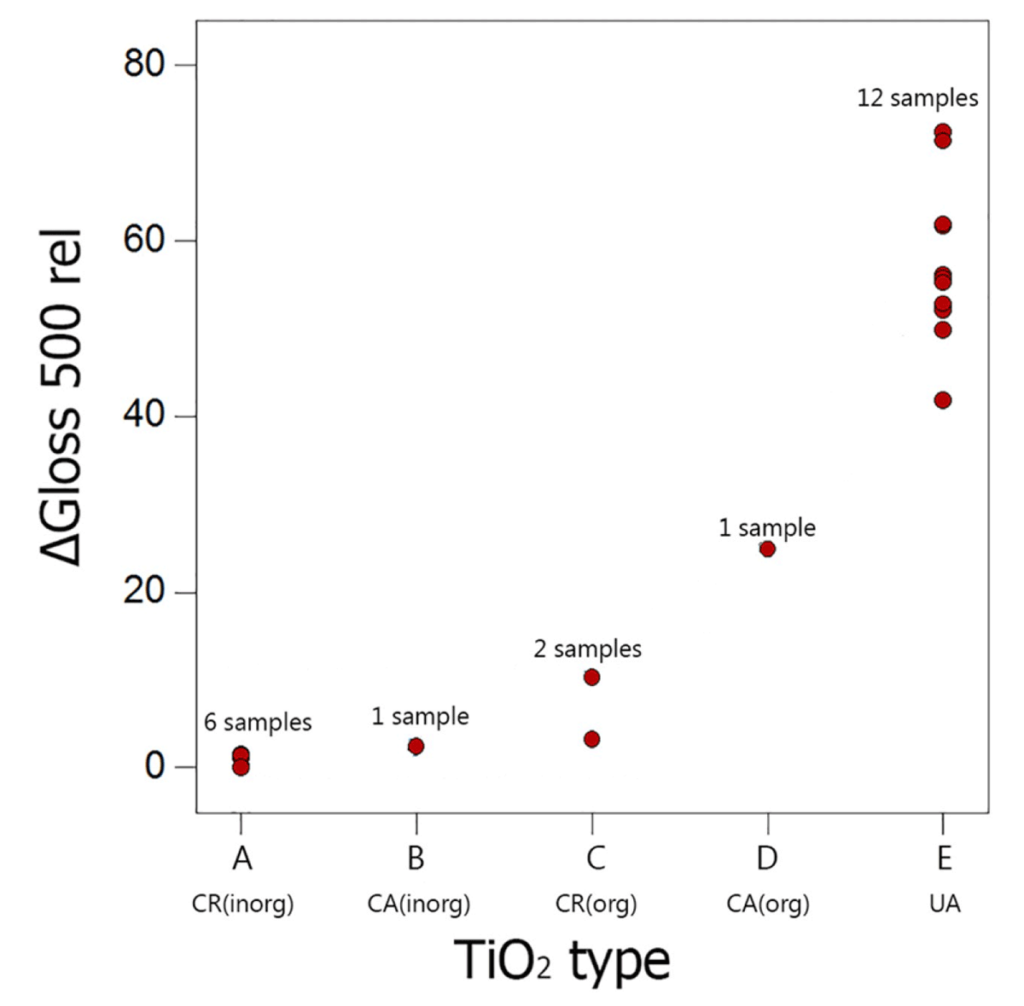
Figure 1. This graph shows how quickly various types of titanium white pigments cause oil paint to lose its surface gloss when exposed to UV light. The uncoated anatase pigment (right side of the graph) causes the most rapid degradation, while the inorganically coated rutile pigment (left side) maintains its gloss and integrity much longer. This visual confirms why modern titanium white oil paints should use coated rutile for long-term stability. (Van Driel, et al.)
Titanium White Oil Paint and the Influence of Zinc Oxide
While rutile pigments offer enhanced stability, paint manufacturers frequently incorporate zinc oxide (ZnO) into titanium white formulations to adjust transparency, handling characteristics, and drying rates. Despite these beneficial properties, recent findings caution artists about the unintended photocatalytic activity of zinc oxide. Zinc oxide unexpectedly exhibits high photocatalytic activity because its surface can readily generate reactive oxygen species under UV exposure, similar to anatase pigments. This property enables zinc oxide to accelerate the degradation of oil binders significantly, raising concerns about its use in paints intended for long-term stability.
Consequently, artists should carefully assess their reliance on zinc oxide-containing paints. In practice, reducing the proportion of zinc oxide or avoiding its use altogether, particularly in surface layers or those exposed directly or indirectly to sunlight, can significantly minimize the risk of premature degradation and ensure greater longevity of the painting.
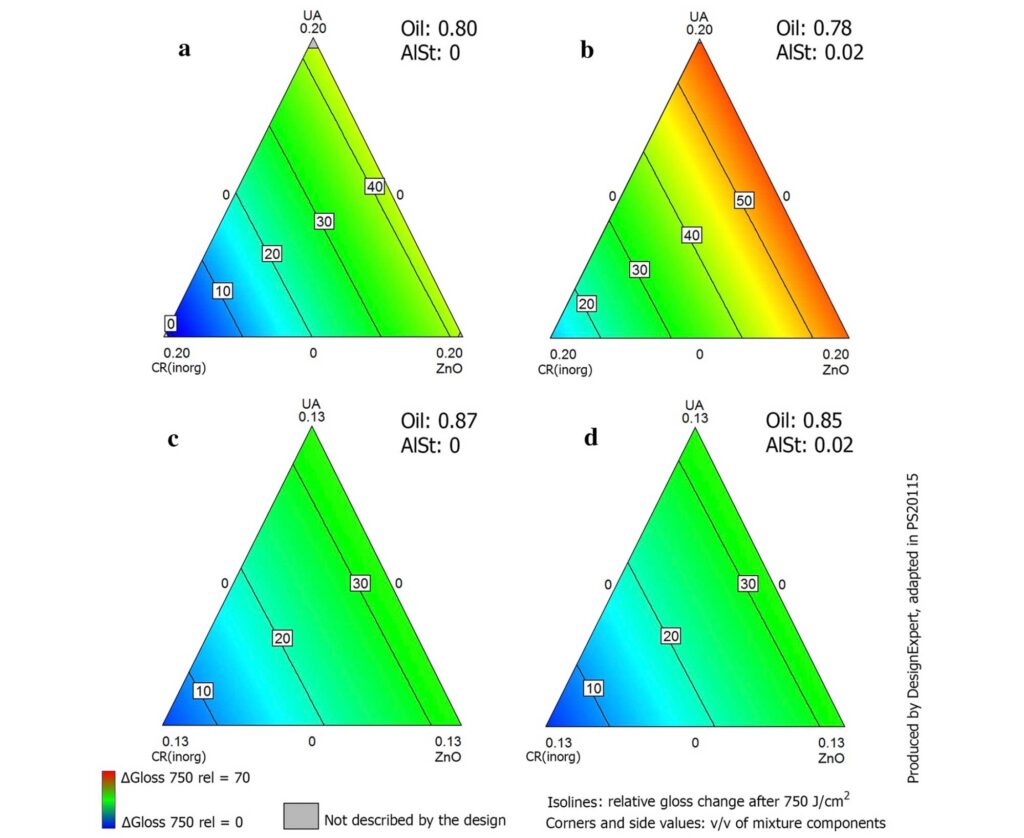
Figure 3. These contour maps show the combinations of titanium white, zinc oxide, oil, and aluminum stearate and how they affect gloss loss after UV exposure. Areas in red indicate greater damage. Paints with low oil content and higher zinc oxide or aluminum stearate degrade more quickly, leading to a dull surface and compromised film. Artists can use this data to avoid formulations that mix zinc white or stearates with low-binder paints. (Van Driel, et al.)
How Extender Pigments Affect Titanium White Oil Paint
Extender pigments like barium sulfate (BaSO₄) and calcium carbonate (CaCO₃) are routinely added to oil paints to alter texture, enhance bulk, and reduce manufacturing costs. Although these extenders offer certain aesthetic and practical benefits, their effects on paint stability must not be overlooked. The research highlights that both extenders facilitate deeper UV penetration, which increases the photocatalytic activity within the paint film.
Want to read the full article and unlock all resources? Choose an option below:
Discover how modern oil paint stability is influenced by components like zinc oxide and aluminum stearate. Learn essential insights for artists and conservators.
Oil paint additives explained—stearates, waxes, fillers, and humidity effects—with best practices to prevent water-sensitivity, soaps, dulling, and cracking.
Discover how barite (baryte or blanc fixe) has shaped oil painting from the 18th century to today. Learn its properties, uses, and hidden drawbacks—why it stabilizes paint but can cause brittleness or “chalking” when overused.
Love this info, I don’t use Titanium much but it is great to know this. To summarize if we want to use Titanium, make sure it is coated and that it doesn’t contain extenders when painting in the top coats. If Titanium is used with an alkyd does it keep a glossy sheen or does it still break down?
Report
There was a problem reporting this post.
Block Member?
Please confirm you want to block this member.
You will no longer be able to:
See blocked member's posts
Mention this member in posts
Invite this member to groups
Message this member
Add this member as a connection
Please note:
This action will also remove this member from your connections and send a report to the site admin.
Please allow a few minutes for this process to complete.
Report
You have already reported this .
Subscribe to Our Newsletter
To begin reading the content, join thousands of artists enjoying our articles. Subscribe to receive updates on artists materials and practices.




Interesting article. Good reading and good information. I use Titanium white exclusively.
Love this info, I don’t use Titanium much but it is great to know this. To summarize if we want to use Titanium, make sure it is coated and that it doesn’t contain extenders when painting in the top coats. If Titanium is used with an alkyd does it keep a glossy sheen or does it still break down?