Artists have relied on drying oils as a primary medium since the Renaissance, appreciating their flexibility, durability, and aesthetic qualities. However, preventing yellowing in oil paintings remains a key challenge for preserving their original appearance and artistic integrity. However, drying oils can yellow over time, impacting the visual integrity of artworks. Recent research by Cairns and Forbes (2020), presented in their paper titled “Insights into the yellowing of drying oils using fluorescence spectroscopy,” offers valuable guidance on selecting and managing drying oils to mitigate discoloration.
Differential Yellowing Among Oils
The study identifies significant differences among commercially available drying oils in terms of yellowing tendencies. Linseed oil, commonly chosen for its fast drying properties, exhibits considerable yellowing due to its high content of unsaturated fatty acids such as linolenic and linoleic acids. In contrast, poppy seed oil demonstrates moderate yellowing, and stand oil—a pre-polymerized form of linseed oil—shows minimal discoloration.
Fatty Acids
Linseed oil (%)
Poppy seed oil (%)
Walnut oil (%)
Safflower oil (%)
Palmitic acid (C16:0)
6–8
8–12
3–7
5.5–7
Stearic acid (C18:0)
3–6
2–3
0.5–3
2–3
Oleic acid (C18:1)
14–24
12–17
9–30
10–35
Linoleic acids (C18:2)
14–19
55–65
57–76
55–81
Linolenic acid (C18:3)
48–60
3–8
2–16
0–1
Techniques for Preventing Yellowing in Oil Paintings
Application Techniques to Prevent Yellowing
Applying thin, uniform layers of paint promotes even drying, minimizing yellowing and surface cracking. Although the Cairns and Forbes study does not explicitly detail why thin layers reduce discoloration, it is widely supported that thinner layers dry uniformly, preventing uneven oxidation and reducing the extent of visible yellowing.
Considerations When Using Water-Miscible Linseed Oils
Cairns and Forbes (2020) found that water-miscible linseed oil, which contains emulsifiers to increase water solubility, yellows significantly more after curing compared to traditional linseed oil. The presence of emulsifiers possibly facilitates chemical reactions during curing, accelerating discoloration. Thus, artists aiming for long-term color stability should consider traditional drying oils without emulsifiers.
Optimal Storage and Display Conditions
Storage and display conditions greatly influence yellowing rates. Dark environments notably accelerate discoloration, whereas controlled exposure to indirect or diffused natural light or museum-quality artificial lighting effectively maintains original color integrity. Artists and collectors should carefully manage lighting conditions to balance these factors effectively.
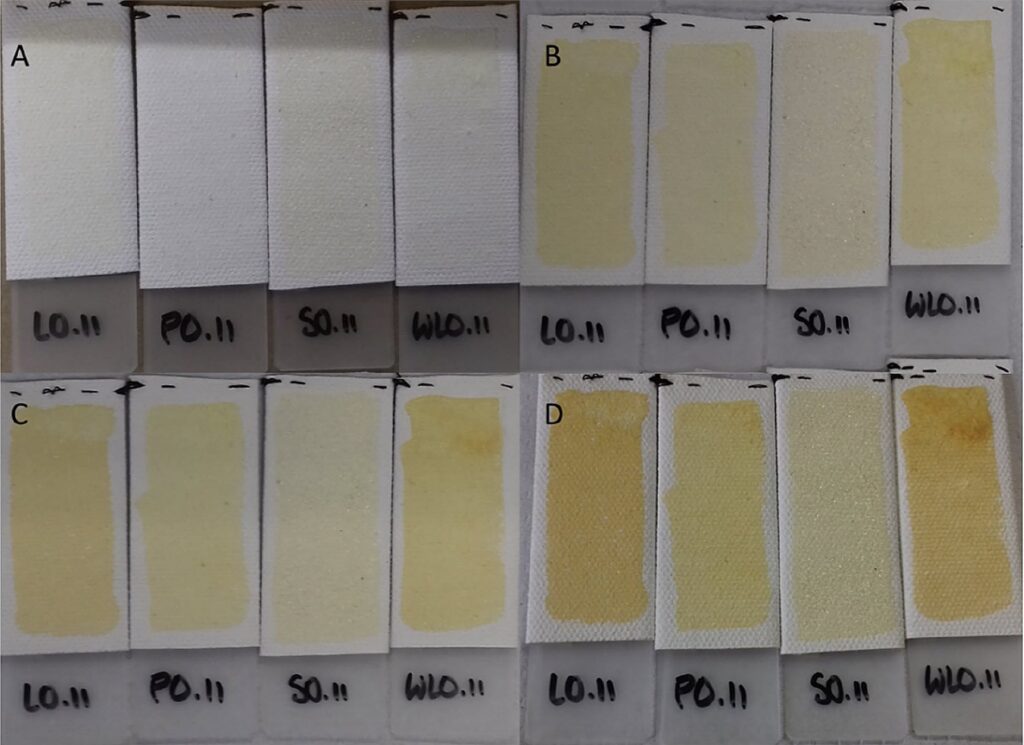
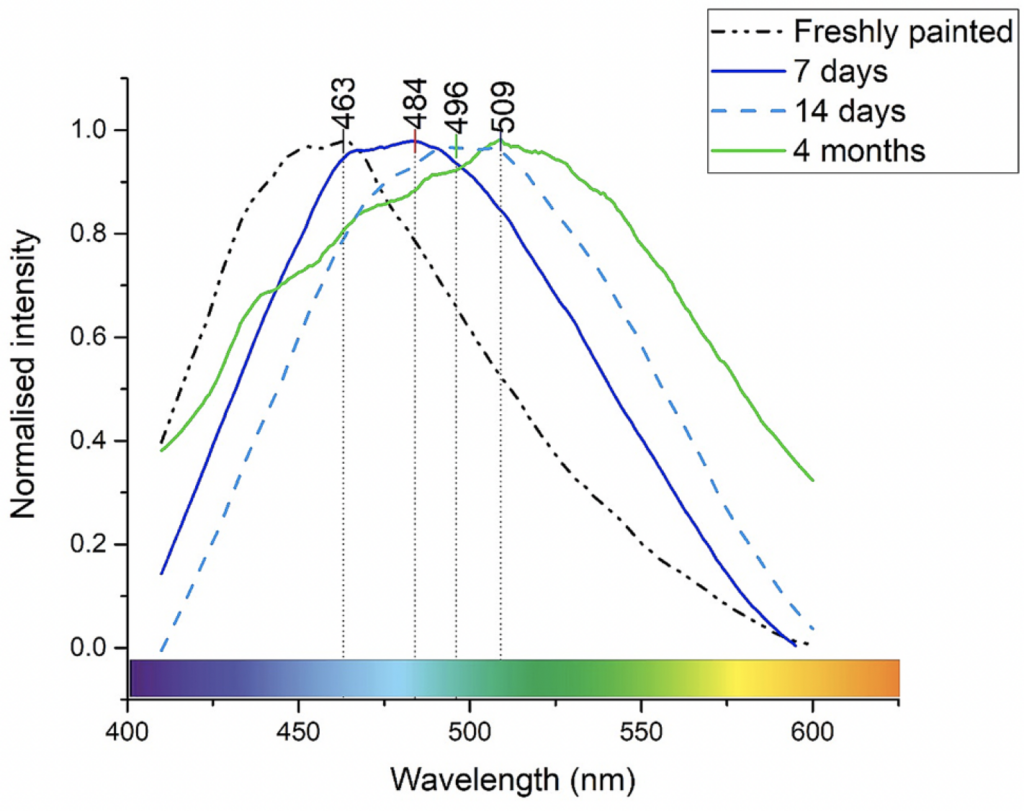
Figure 1:Visual representation of yellowing progression in linseed oil films. From left to right: freshly painted oil (a), after 7 days (b), 14 days (c), and 4 months (d) stored in darkness following initial 24-hour UV-light exposure. This simulated aging highlights the severe discoloration potential when artworks are stored in prolonged darkness.Figure 2:This graph shows how the fluorescence spectrum of aged linseed oil changes after exposure to UV light for 24 hours and subsequent storage in darkness. The x-axis represents the emission wavelength, while the y-axis shows the fluorescence intensity. Initially, the oil fluoresces at a shorter wavelength (blue light), but as the oil ages and yellows, the fluorescence shifts to a longer wavelength (green-yellow light). This shift, known as a bathochromic shift, indicates the chemical changes in the oil’s structure that occur during the aging and yellowing process. The excitation wavelength for all measurements was 360 nm. This evidence reinforces how light exposure and subsequent storage conditions influence the yellowing of linseed oil in paintings.
Due to the cyclic nature of yellowing and bleaching, discoloration alone may not reliably indicate artwork age. While sunlight can reverse discoloration, excessive exposure risks pigment degradation. Artists and conservators should thus manage lighting exposure carefully.
Want to read the full article and unlock all resources? Choose an option below:
Painting on wood panels? Learn how plywood, MDO, and HDO boards serve as durable supports. This guide covers stability, surface prep, pros & cons, and best practices for oil, acrylic, and tempera.
Fat over lean explained with PVC/CPVC. Learn how tube paint, solvents, and mediums change film strength, flexibility, and cracking risk in layered oil and alkyd painting.
thank you for your insightful offering. How does one avoid linseed oils with emulsifiers? does this imply water washing oil to rid off the impurities? which of the oils offered by naturalpigments do not have emulsifiers in them? please kindly advice. very best regards
Avoid water-miscible oil paints, as they contain linseed oils with emulsifiers. Natural Pigments does not make water-miscible oil paints.
Report
There was a problem reporting this post.
Block Member?
Please confirm you want to block this member.
You will no longer be able to:
See blocked member's posts
Mention this member in posts
Invite this member to groups
Message this member
Add this member as a connection
Please note:
This action will also remove this member from your connections and send a report to the site admin.
Please allow a few minutes for this process to complete.
Report
You have already reported this .
Subscribe to Our Newsletter
To begin reading the content, join thousands of artists enjoying our articles. Subscribe to receive updates on artists materials and practices.




thank you for your insightful offering. How does one avoid linseed oils with emulsifiers? does this imply water washing oil to rid off the impurities? which of the oils offered by naturalpigments do not have emulsifiers in them? please kindly advice. very best regards
Avoid water-miscible oil paints, as they contain linseed oils with emulsifiers. Natural Pigments does not make water-miscible oil paints.