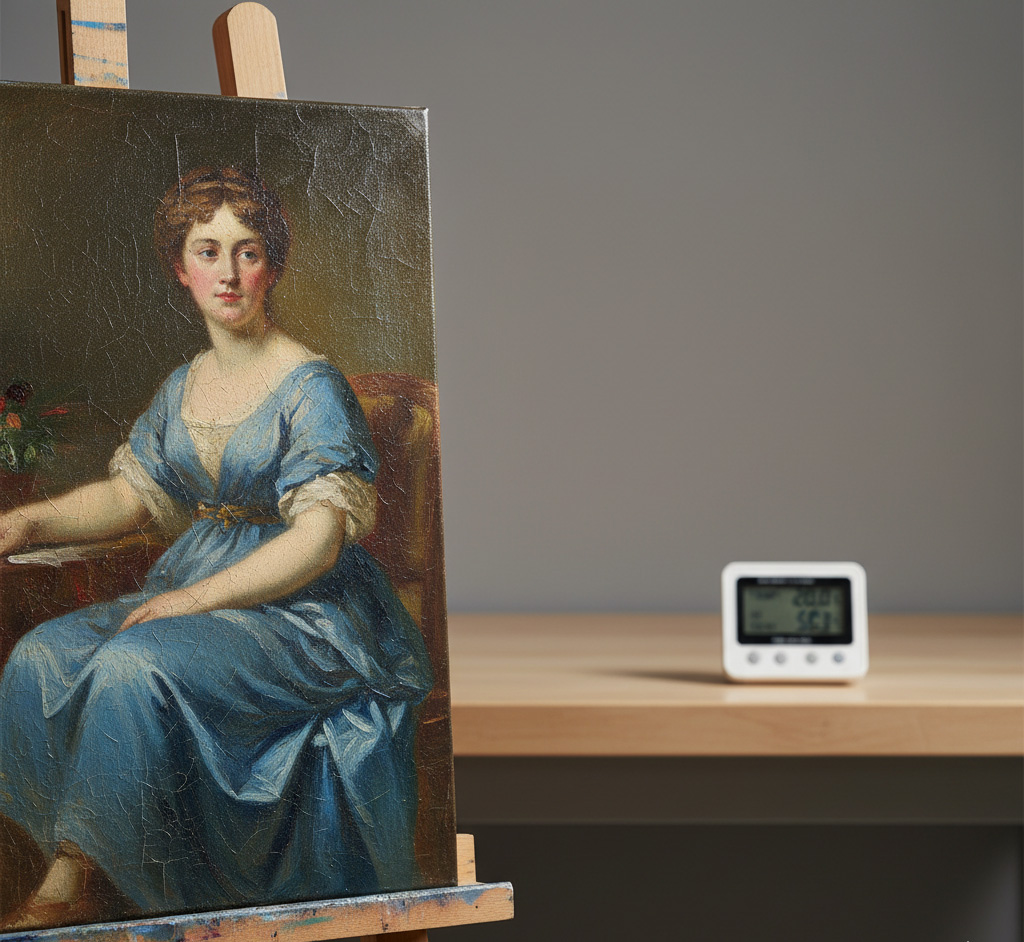
Oil painting on canvas under raking light showing fine craquelure, with hygrometer at 50% RH and an aluminum backboard in a conservation studio.

Oil Paint Cracking: Moisture, Canvas, and Best Practices

Jump to Oil Paint Cracking—Causes & Prevention

Oil paint cracking often begins with moisture. Relative humidity (RH) moves through canvas, size, and paint, creating stress that opens fissures or weakens bonds (Freddi and Mingazzi 2025). This review translates a mechanics paper into studio practice, showing how to prevent oil paint cracking and how to care for finished work.

Why moisture matters for oil paint cracking

Moisture is the silent mover in a canvas painting. When relative humidity (RH) rises, hygroscopic layers—especially the fabric support and any animal‑glue size—take up water and swell. When RH falls, those same layers release water and shrink. Oil paint films respond more slowly and to a smaller degree. This mismatch sets up internal pulling and pushing forces that, over many cycles, can lead to oil paint cracking or to a gradual loss of adhesion where layers meet (Freddi and Mingazzi 2025).

Because the back of the canvas is often the most exposed pathway for moisture, localized sources—cool exterior walls, damp basements, or a crate that sat overnight on a concrete floor—can create pockets of higher RH behind the picture. The model reviewed here shows how that local imbalance concentrates stress near the stretcher and tacking margins, which is where many cracks first appear (Freddi and Mingazzi 2025).

Small, slow changes are far safer than sharp swings. A painting can tolerate moderate RH shifts if they happen gradually. However, day–night jumps or rapid travel between climates produce steep moisture gradients: the fabric swells or shrinks faster than the paint can follow. That is when oil painting cracks tend to initiate.

What the study shows (in plain terms)

The authors treat a painting as three cooperating parts: a fabric support, a thin adhesive interface (such as animal‑glue size), and an oil‑paint layer. They couple moisture transport with mechanical response. As RH changes, each layer gains or loses moisture according to its own sorption behavior. That moisture change alters the layer’s size and stiffness. When the accumulating stress exceeds the paint’s toughness, a crack starts and grows. When the interface becomes the weak link, the bond lets go and delamination spreads (Freddi and Mingazzi 2025).

Want to read the full article and unlock all resources? Choose an option below:

Already a member? Log in to continue Try 7 days free — $0
Cancel anytime · 30-day money-back guarantee

Related Articles

Responses

Leave a Reply to Christopher Laffin

Your email address will not be published. Required fields are marked *


Cancel reply

Subscribe to Our Newsletter

To begin reading the content, join thousands of artists enjoying our articles. Subscribe to receive updates on artists materials and practices.

Or Join as Member for More Benefits