Understanding the properties of pigments is important for artists seeking to master color and texture in their work. The study “Effect of Particle Size on Pigments Colour” by Anna M. Gueli and colleagues provides critical insights into how the size of pigment particles can influence color, opacity, and other optical properties in paintings. This article unpacks these findings, focusing on their practical implications for artists.
The authors of the study aimed to investigate the intricate relationship between pigment particle size and the resulting optical characteristics in historical and artistic paints. Their primary objective was to quantify how variations in particle size influence color properties such as hue, brightness, saturation, and hiding power, with a specific focus on pigments used in casein paint. By employing spectrophotometric analysis and morphological observations through scanning electron microscopy, they sought to provide a scientific basis for understanding how these physical characteristics affect the visual outcomes in paintings. This research not only offers insights into historical art practices but also provides valuable guidance for contemporary artists in selecting and utilizing pigments to achieve desired aesthetic effects.
Hue
Pigments
BLUE
Indigo, pale blue
Cobalt blue pale
Indigo pale blue
Lapis lazuli
GREEN
Chrysocolla
Malachite
Green earth
Viridian
RED
Red bole
Caput mortuum reddish
Sinopia
YELLOW
French ochre JCLES
Yellow ochre
Raw Sienna
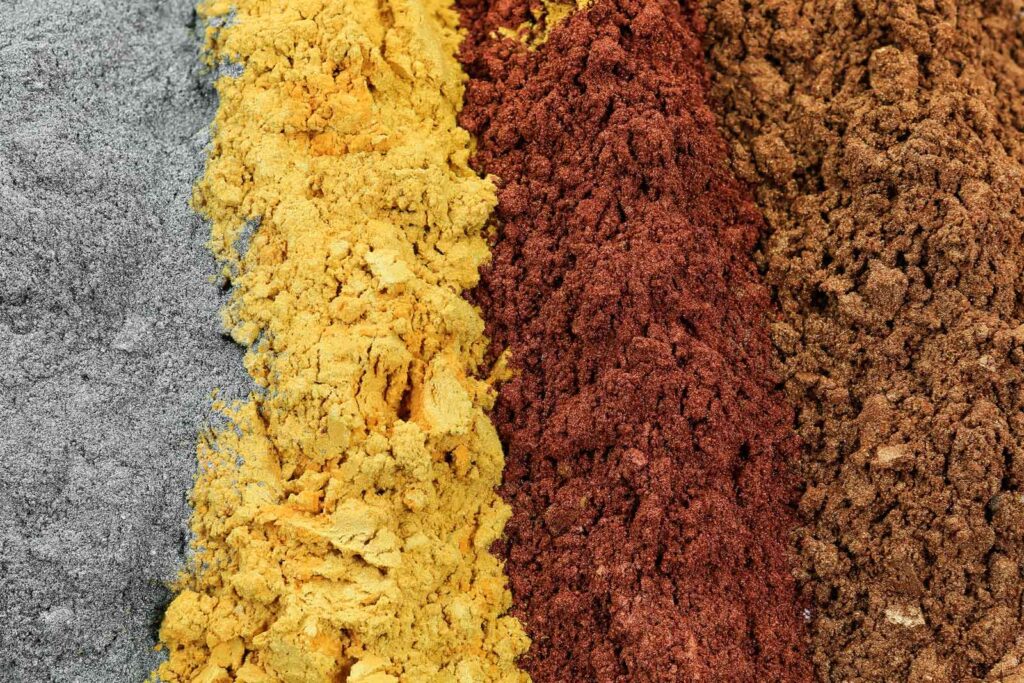
Historical pigments studied by the authors.
The Impact of Pigment Particle Size on Optical Properties
The interaction between pigment particles and light is a fundamental aspect of paint behavior, influencing both its aesthetic and functional qualities. Central to this interaction are the physical characteristics of the pigments—namely, their morphology and spectral reflectance properties. Understanding these attributes is essential for artists aiming to achieve precise control over opacity, brightness, and color intensity in their work. This section delves into how particle size and shape, along with their spectral reflectance factor (SRF), determine the visual and optical properties of paints, particularly when pigments are used in different mediums such as pure pellets and casein-based binders.
Particle Morphology: Particle morphology refers to the size and shape of pigment particles. These characteristics significantly impact how pigments interact with light, which in turn affects the paint’s visual properties. The study outlines that smaller particles tend to increase the hiding power of pigments, making them more opaque. This is crucial when aiming for a more solid coverage in painting layers.
Spectral Reflectance Factor (SRF): SRF measures how much light a pigment reflects across the visible spectrum. The study demonstrates that SRF increases as particle size decreases in pigment pellets. However, in paint layers mixed with a binder like casein, the opposite trend is observed due to the interaction between the binder and pigment particles.
The Science Behind Pigment Particle Size: Hiding Power and Tinting Strength
Hiding Power: At its core, hiding power is the ability of a pigment to render the medium opaque. This quality is crucial when an artist wants a solid, non-transparent color layer. Hiding power is influenced by the difference in refractive index between the pigment and the dispersing medium (such as a binder). Essentially, pigments with a higher refractive index than the binder will scatter light more effectively, resulting in greater opacity.
Want to read the full article and unlock all resources? Choose an option below:
What happens when your painting ground cracks? New research on gesso fracture toughness, acrylic primers, and zinc white reveals what your ground choice means for longevity.
Let’s toss out the concepts of “fat over lean” and for that matter “thick over thin” (or the confused “thick over lean”) while we are at it, and let’s consider the physical structure of the paint.
Water gilding gesso and bole, decoded from Portuguese Baroque treatises and laboratory reconstruction. Practical guidance for artists who want recipes that work.
Please note:
This action will also remove this member from your connections and send a report to the site admin.
Please allow a few minutes for this process to complete.
Report
You have already reported this .
Subscribe to Our Newsletter
To begin reading the content, join thousands of artists enjoying our articles. Subscribe to receive updates on artists materials and practices.






Responses