Understanding Canvas Preservation and Microclimate Stability
Artists often focus on the front of a painting—the image, surface, and varnish. Yet the preservation of canvas paintings also depends significantly on conditions at the back. A 2020 study by Padfield et al. published in Heritage Science offers valuable insights into how canvas preservation can be enhanced through back protection strategies that influence the microclimate behind stretched paintings.
The study investigates how temperature gradients and moisture interactions affect the relative humidity (RH) within the enclosure formed by a stretched canvas and its backing, providing critical data for optimizing canvas preservation methods. These findings are highly relevant to artists who wish to extend the life of their work while minimizing structural degradation. For example, artists who display work in seasonal climates might use sealed, non-absorbent backing boards to reduce RH fluctuations and prevent warping or delamination—particularly when hanging canvases on exterior walls or in rooms without humidity control.
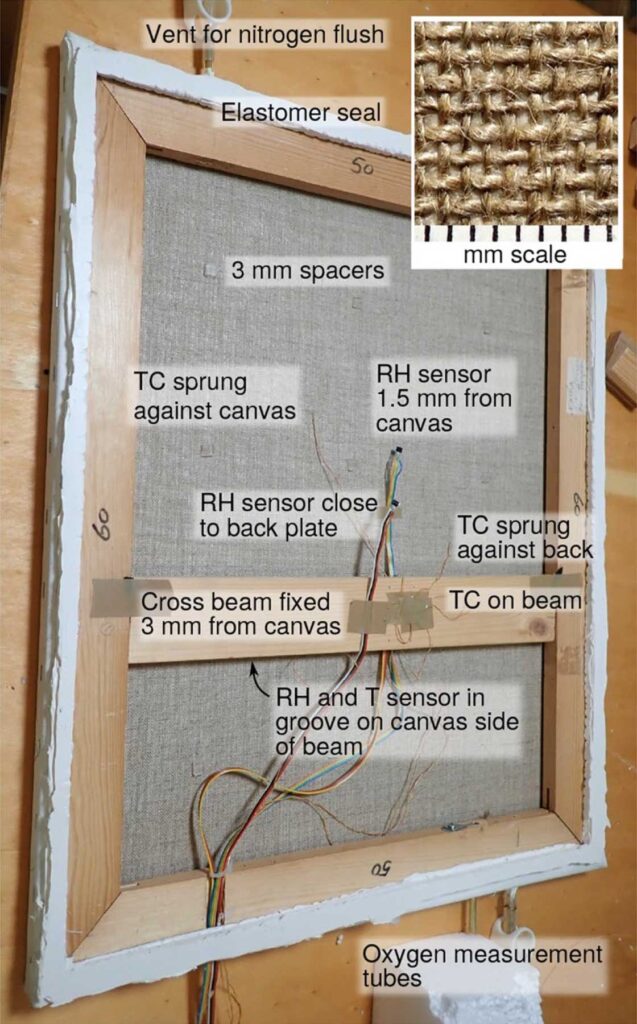
Figure 1: Back View of the Experimental Canvas with Sensors A back view of the experimental canvas stretched over a wooden frame. The thermocouples (TC), which spring against both the canvas and the back plate, are scarcely visible. RH sensors with integrated temperature measurements are positioned to monitor the microclimate. A third RH sensor is embedded in a shallow groove on the cross beam, facing the canvas. The inset at the top right displays the weave of the linen canvas and the ground layer on the painted side.Figure 4: Dimensions of the Experimental Painting Assembly This schematic illustrates the dimensions and spatial configuration of the experimental painting setup, including the canvas, stretcher, backboard, and sensor positions. It clarifies how various components were arranged and spaced in relation to each other and the wall, providing context for interpreting the humidity and temperature data recorded throughout the study.
Why the Back of the Canvas Matters
The canvas, especially when stretched on a wooden frame, is exposed to fluctuations in temperature and humidity. These fluctuations can cause expansion, contraction, and stress on the paint and ground layers. The authors show that relative humidity changes are often driven not by direct moisture intrusion but by temperature gradients interacting with enclosed air and hygroscopic materials.
Without any backing, the rear of a painting is vulnerable. Air exchange with the room can lead to significant relative humidity (RH) swings behind the canvas, particularly when the painting hangs on an exterior wall. The combination of cold wall surfaces and room air of higher moisture content creates a risk of condensation.
Figure 6: RH and Temperature Fluctuations Behind an Unprotected Canvas This figure illustrates a 4-hour cycle of wall temperature, with an average temperature below ambient, simulating exposure to a cold wall. The painting, mounted without back protection and with a 10 mm gap from the wall, experienced sharp RH increases near the canvas surface. The shaded band illustrates the difference between RH measured near the canvas and RH calculated based on temperature (RH-c). The figure also illustrates how canvas temperature lags behind room air, highlighting the influence of surface temperature gradients on moisture behavior.Figure 7: RH and Temperature Behavior with Aluminium Back Plate This figure shows the RH and temperature conditions when a painting is backed by an aluminum plate and spaced 10 mm from a cold wall. The added curves display both the RH and temperature close to the back plate. The data demonstrate how impermeable back protection modifies the microclimate behind the canvas by stabilizing RH near the canvas but introducing significant RH variation near the colder back plate surface. This figure underscores the need for careful thermal management in sealed systems.
Impermeable Back Boards and Their Benefits
One of the most critical conclusions from the study is that sealing the back of a painting with a non-absorbent, impermeable material offers strong protection. An aluminum sheet, tightly sealed to the frame and held 10 mm away from the wall, effectively stabilized the RH in the space behind the canvas.
This construction limits moisture exchange, allowing the canvas itself to act as the primary humidity buffer. This is preferable because the canvas remains at a more consistent temperature than other components, minimizing conflicting moisture exchange and reducing RH instability across the enclosure. The RH behind the canvas remained nearly constant, even during temperature cycles mimicking daily fluctuations.
Want to read the full article and unlock all resources? Choose an option below:
Painting on wood panels? Learn how plywood, MDO, and HDO boards serve as durable supports. This guide covers stability, surface prep, pros & cons, and best practices for oil, acrylic, and tempera.
What happens when your painting ground cracks? New research on gesso fracture toughness, acrylic primers, and zinc white reveals what your ground choice means for longevity.
Please note:
This action will also remove this member from your connections and send a report to the site admin.
Please allow a few minutes for this process to complete.
Report
You have already reported this .
Subscribe to Our Newsletter
To begin reading the content, join thousands of artists enjoying our articles. Subscribe to receive updates on artists materials and practices.






Responses