Why This Paper Matters for Artists Concerned About Oil Paint Cracking
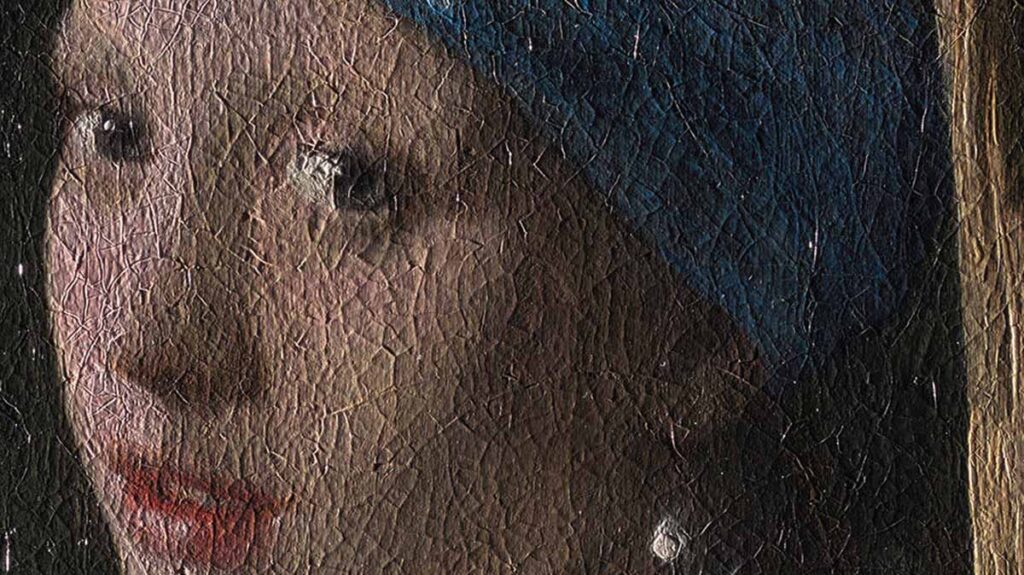
Oil paint cracking has troubled artists for centuries. A painting can remain chemically stable for generations and still develop visible cracks, cleavage, and flaking within a few decades. Understanding why requires knowing how much energy it actually takes to break an aged paint film apart. Until recently, that number was missing from the scientific literature, which meant artists making durability decisions at the easel were working from intuition rather than measurement.
The study by Arkadiusz Janas, Nefeli Avgerou, Maria Charalambides, Laura Fuster-López, and Łukasz Bratasz fills that gap (Janas et al. 2024). Using samples from Marion Mecklenburg’s Paint Reference Collection — oil films naturally aged between 23 and 33 years — the authors measured the Mode I fracture toughness, written as GIc, of eleven single-pigment oil paints. The results directly explain why oil paint cracking tends to appear in specific pigments, specific film locations, and specific decades of a painting’s life. For practicing artists, the implications extend directly to layer structure, pigment choice, and storage decisions.
The Core Finding in One Sentence
Aged oil paints have average fracture toughness values between 10 and 40 J/m² — roughly one-tenth the toughness of the traditional animal-glue gesso ground beneath them (Janas et al. 2024, p. 1, abstract; p. 6, conclusions; cf. Table 3).
This is the headline range the authors give in both their abstract and their conclusions. It captures the behavior of ten of the eleven paints tested. The eleventh, sap green, is an outlier: its average GIc of 83 J/m² (with individual measurements as high as 180 J/m²) sits well above the headline range, due to its unusual chemical aging behavior, discussed below. For the working palette of pigments most artists actually use — lead white, zinc white, titanium white, raw umber, verdigris, malachite, ultramarine, and the iron oxides — the 10–40 J/m² band describes what to expect.
A note on what “gesso” means here. The word “gesso” is used loosely in modern art supply catalogs and can refer to several very different materials. In this article, when we cite the ~100 J/m² gesso benchmark, we mean only the traditional animal-glue gesso: rabbit-skin glue mixed with chalk (calcium carbonate), prepared following the historical recipe in Cennino Cennini’s early-fifteenth-century treatise. That is the material whose fracture toughness was directly measured by Bratasz, Akoglu, and Kékicheff (2020) and quoted by Janas et al. (2024) as the comparison standard. It is not the same as the products commonly sold as “acrylic gesso,” which are acrylic-polymer primers loaded with titanium white and extenders. It is also not the same as oil grounds (lead white in linseed oil), half-chalk grounds, casein gessoes, or alkyd primers. The fracture toughness of those alternatives has not, to date, been published. So when this article says oil paint is roughly one-tenth the toughness of “gesso,” that comparison applies cleanly only to traditional glue grounds. An artist working over an acrylic primer or an oil ground is in less well-charted territory, and should not assume the same toughness ratio holds.
That single number rearranges the mental model many artists carry. For decades, the received wisdom has held that the ground is the brittle, vulnerable layer and that the paint film, being slightly more flexible, rides on top of it safely. The Janas data show the opposite for aged work, at least for paint over a traditional glue ground. By the third decade of aging, oil paint films are often the mechanically weakest layer in the stack. The ground is stronger. The canvas or panel is stronger still. When stress accumulates, the paint cracks first — and that is the quiet mechanism behind most cracking in mature oil paint.




There is also the role, in more traditionally prepared painting supports, that hide glues – when used as an artist-applied canvas size – play in cracking and dimensional changes to the overall paint laminate.