The question of whether watercolor paintings can—or should—be varnished continues to divide artists. Many watercolorists dislike the visual intrusion of glazing, yet they also recognize the need to protect vulnerable paper supports and water‑sensitive paint layers. This tension has led some contemporary artists to explore varnishing watercolor as a modern best practice or, at minimum, an expedient compromise when traditional glazing is undesirable.
However, varnishing watercolor is not a modern invention. One of its earliest and most technically ambitious practitioners was Thomas Gainsborough. In the late 1760s and early 1770s, Gainsborough developed a complex hybrid technique combining dry‑applied lead white, protein fixation, watercolor washes, and spirit varnish. Jonathan P. Derow’s 1988 technical and historical study provides the most thorough examination of this approach to varnishing watercolor and its material consequences.
This review evaluates varnishing watercolor through Gainsborough’s technique from the perspective of contemporary artists, with particular attention to what the historical evidence reveals about durability, risk, and long‑term appearance.
Historical Context and Purpose
Gainsborough was trained and professionally established as an oil painter. Nevertheless, like many British artists of the eighteenth century, he sought to elevate watercolor beyond its role as a preparatory or amateur medium. His goal was not subtlety or transparency, but rather optical richness comparable to that of oil painting.
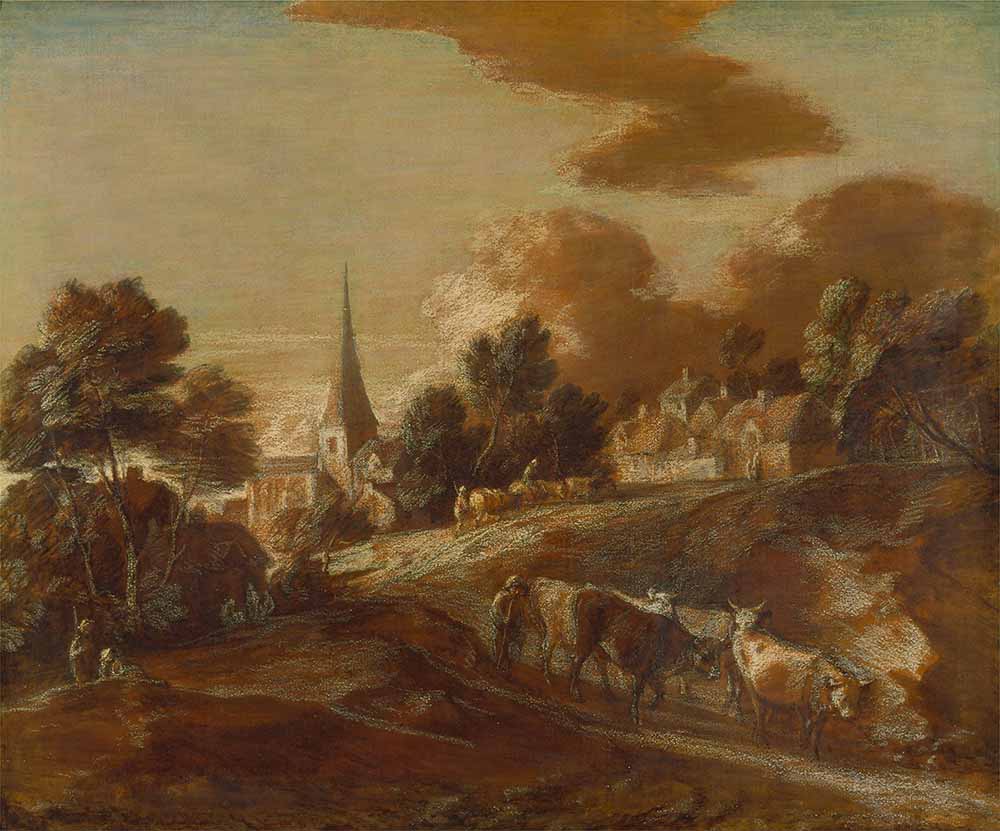
In a detailed letter dated January 29, 1773, Gainsborough described a multistep process for producing watercolors that could rival oil sketches in depth, opacity, and surface gloss. These works were later exhibited at the Royal Academy in 1772 as “drawings, in imitation of oil paintings.” The designation is critical. Gainsborough himself framed these objects as hybrids rather than orthodox watercolors.
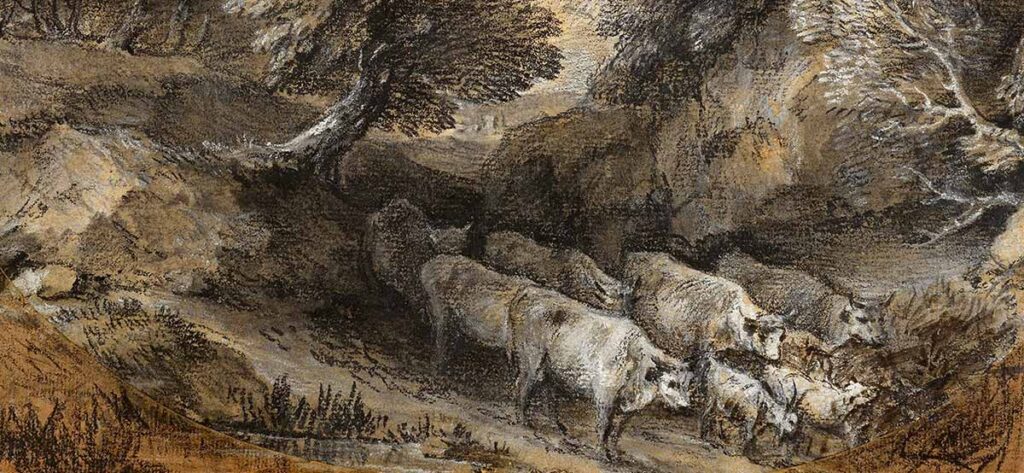
Figure 1. Thomas Gainsborough, An Imaginary Wooded Village with Drovers and Cattle Watercolor and oil on paper, varnished. Yale Center for British Art. One of Gainsborough’s large, fully varnished watercolors exhibited in 1772 as “drawings, in imitation of oil paintings.” The glossy surface and oil-like depth illustrate the aesthetic goal that motivated varnishing watercolor.
Materials and Working Method in Varnishing Watercolor
Paper and Preparation
Gainsborough worked on laid paper, sometimes later mounting it to canvas or board. The texture of the laid paper served a functional role, allowing dry pigment to adhere to the raised ribs while leaving the valleys relatively untouched.
Want to read the full article and unlock all resources? Choose an option below:
Painting on wood panels? Learn how plywood, MDO, and HDO boards serve as durable supports. This guide covers stability, surface prep, pros & cons, and best practices for oil, acrylic, and tempera.
What happens when your painting ground cracks? New research on gesso fracture toughness, acrylic primers, and zinc white reveals what your ground choice means for longevity.
Please note:
This action will also remove this member from your connections and send a report to the site admin.
Please allow a few minutes for this process to complete.
Report
You have already reported this .
Subscribe to Our Newsletter
To begin reading the content, join thousands of artists enjoying our articles. Subscribe to receive updates on artists materials and practices.




Responses