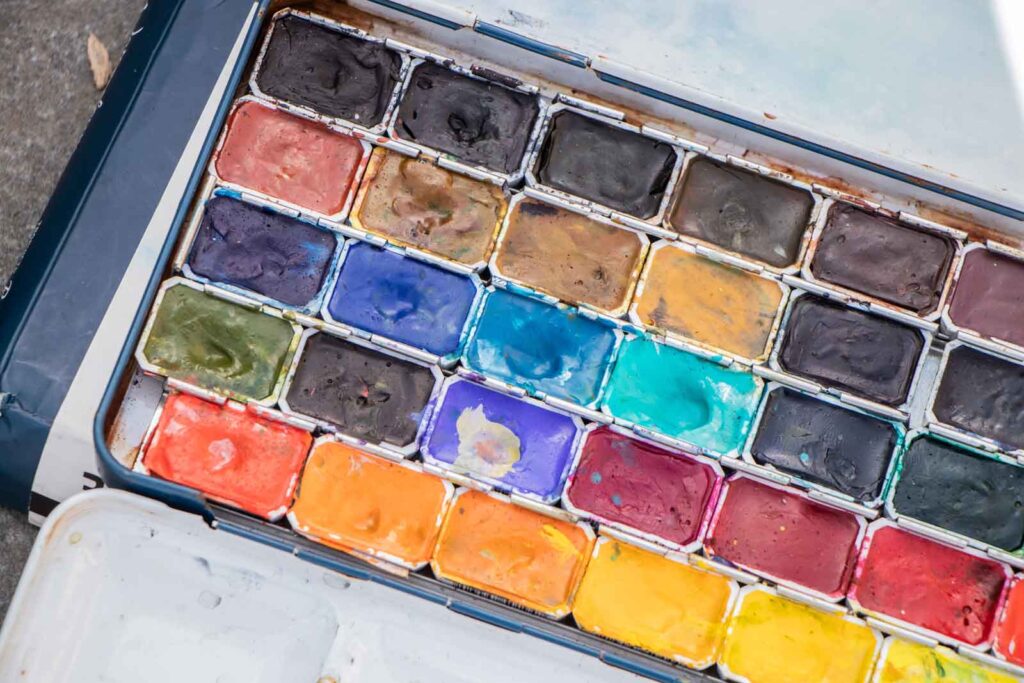
The wash-fastness of watercolor paints—a crucial factor for artists and conservators aiming to preserve the integrity of their works—determines how well pigments resist fading or movement when exposed to water. In his paper, “Factors Influencing the Wash-Fastness of Watercolours,” Vincent Daniels explores the importance of watercolor wash-fastness, analyzing how pigment composition, binder solubility, and paper characteristics affect a paint’s durability. Published in The Paper Conservator, Daniels’ research provides critical insights for artists, offering guidance on how material choices and techniques can significantly enhance the longevity and stability of watercolor art. This article summarizes Daniels’ findings, providing actionable advice to help artists create works that withstand the test of time.
Why Wash-Fastness Matters in Watercolor Painting
Watercolor paintings are distinct for their fluidity and transparent layering, qualities that can make them vulnerable to pigment movement when exposed to water. Conservators often employ aqueous cleaning, or “washing,” to remove stains, discoloration, or impurities that accumulate on a painting’s surface over time. However, this process poses risks, as certain pigments—especially lake pigments derived from organic dyes—are prone to bleeding and color migration. Daniels’ study underscores this concern, highlighting the importance of selecting wash-fast pigments to prevent unwanted color shifts during conservation treatments. For artists, understanding wash-fastness is essential, particularly when creating works intended for preservation. Factoring in pigment stability from the outset ensures the longevity and integrity of their art under future handling and conservation.
The Role of Gum Arabic in Watercolor Durability
At the heart of watercolor stability lies the binding agent, typically gum arabic, which suspends pigments and adheres them to the paper surface. Daniels’ research underscores that the solubility of gum arabic has a profound impact on wash-fastness. Over time, gum arabic can become less soluble, especially when mixed with certain metallic elements found in pigments, such as chromium, cobalt, and manganese. This change in solubility, often triggered by the cross-linking of the gum with these metals, results in a more wash-fast and water-resistant paint film. For artists, this implies that choosing watercolors with specific binding and pigment formulations may enhance wash-fastness, particularly for works intended for long-term display or preservation.
How Pigment Composition Affects Watercolor Longevity
Daniels’ study delves into the composition of modern watercolor pigments and their wash-fastness properties. He finds that pigments containing zinc oxide or barium sulfate as extenders are more susceptible to color loss during washing. These materials, while helpful in achieving opacity or specific textural effects, can compromise the durability of watercolors. Artists should consider the potential trade-offs when using paints with these extenders, especially if their work is intended for environments where humidity or cleaning might affect its longevity.
Choosing the Right Paper for Optimal Watercolor Wash-Fastness
The study also emphasizes the importance of paper in determining wash-fastness. Unsized, porous papers, such as filter paper, allow pigments to penetrate deeper, which enhances wash-fastness by embedding pigments within the paper’s fibers. In contrast, heavily sized papers prevent pigments from fully binding to the fibers, making them more susceptible to washing off. Gelatine-sized papers, commonly used for watercolors, block hydrogen bonding sites on cellulose, further reducing pigment adhesion. For artists, understanding how paper choice impacts pigment stability can inform both material selection and intended applications, ensuring the preservation of their works over time.
Relative wash-fastness of fugitive pigments on three different papers
Pigment Name
Pigment Composition
Whatman No. 1
Arches
Whatman Watercolour
Alizarine Carmine
Cadmium sulfide, ferric oxide, and zinc oxide
–
*
**
Antwerp Blue
Prussian blue with alumina and calcium
–
–
*
Azure Cobalt
Cobalt aluminate or phosphate, with alumina, Zn, Cr, Ca, and Fe
–
**
**
Bright Red
Organic dyes on a Ba-containing base with S, Cl, K, Ca, and Fe
–
–
**
Cadmium Orange
Cobalt aluminate or phosphate with alumina
–
–
*
Cadmium Red
Cadmium sulfo-selenides with Ba
–
–
*
Cobalt Blue
Organic dyes on a Ba-containing base with S, Cl, K, Ca, and Fe
–
*
*
Cobalt Green
Complex mixtures of cobalt and zinc oxides with Cu
–
*
*
Cyanine Blue
Prussian blue and cobalt blue
–
–
**
Hooker’s Green
Organic dyes with Ba (barium)
*
*
**
Hooker’s Green Dark
Organic dyes with Ba (barium)
*
*
**
Indigo
Alizarine crimson, lamp black, and Winsor blue, with Ba
–
*
*
Naples Yellow
Cadmium sulfide, ferric oxide, and zinc oxide
*
**
*
New Gamboge
Organic dyes with Ca, Ba, and Zn
–
–
*
Permanent Magenta
Organic dyes on a calcium-containing base
–
–
**
Purple Lake
Alizarine lakes on a base with Ca, Ba, Fe, and Zn
–
–
**
Sap Green
Organic dyes with Zn and Ba
*
*
**
Scarlet Lake
Organic dyes on a base with Ca, Fe, and Cl
–
–
*
Winsor Emerald
Organic dyes with Zn, Ba, and traces of Cu
*
**
**
Winsor Violet
Lake on a barium base with traces of Cu, S, K, and Fe
*
**
**
This table from the paper compares each pigment’s wash-fastness on the three different types of paper used in the study, emphasizing the variability of pigment stability across various substrates. Legend: – = No visible loss of pigment * = Some loss of pigment ** = Most of the pigment lost
Lifting Techniques and Their Impact on Watercolor Wash-Fastness
“Lifting,” or the practice of rewetting and removing dried pigment from paper, is a technique many watercolorists use to achieve subtle tonal variations or corrections. Daniels notes that some pigments, due to their chemical nature, are more challenging to lift once dried. Pigments that stain paper are harder to manipulate after drying, which might benefit artists who prefer a more permanent finish. Knowing which pigments resist lifting can guide artists in their layering and correction techniques, allowing them to work more precisely with staining or non-staining pigments.
Want to read the full article and unlock all resources? Choose an option below:
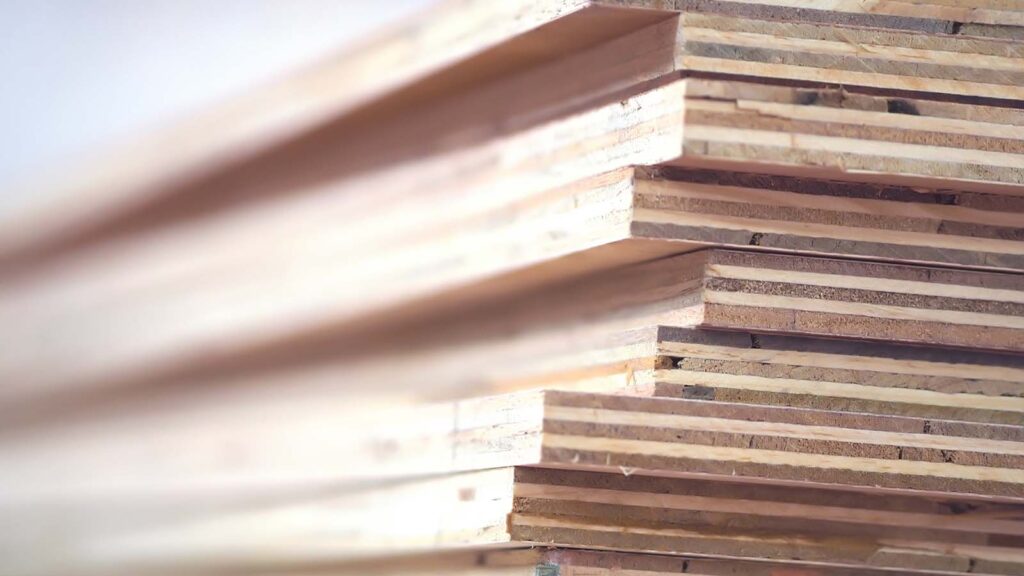
Painting on wood panels? Learn how plywood, MDO, and HDO boards serve as durable supports. This guide covers stability, surface prep, pros & cons, and best practices for oil, acrylic, and tempera.
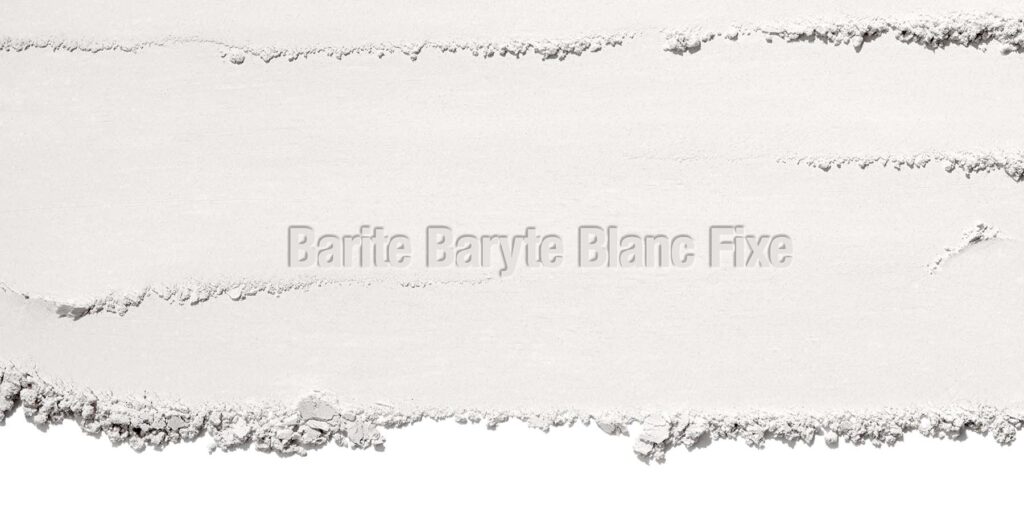
Discover how barite (baryte or blanc fixe) has shaped oil painting from the 18th century to today. Learn its properties, uses, and hidden drawbacks—why it stabilizes paint but can cause brittleness or “chalking” when overused.
Learn how to apply the fat-over-lean rule in oil painting to ensure lasting, flexible layers. Understand its role in medium selection and paint layering.
Explore how essential oils like lavender, clove, and thyme improve oil painting drying times and color retention. Learn practical applications for artists.
This is a wonderful article and one I am most thankful to read and consider. I find myself wishing to understand the light-fast numbers on the watercolor paints better, and to understand which brands are best to recommend for classes. I like the descriptions about watercolor techniques and appreciate this resource. I would love to have some terminology expanded on as there is a lot of confusion over “dry-brush” verses “scumbling” and which media those terms are associated with. My wish is provide cleaner answers to my students instead of furthering any confusion. I just tried to look up whatman #1 and sadly it is discontinued. Would it be possible to do this paper testing on watercolor papers that are widely available? I would love to know! In my classes, we discovered that the artists loft (although usually very poor quality) provided my students with excellent classroom experiences; 1264 fabriano 140 cold press does great, New York Central 100% cotton 140lb is nice to work on and Strathmore 300/400 lb also very nice. If I were to create a work as a commission, what paper provides for the best longevity? (my guess would be something from artefex, but wishing for a more economical option). Thank you!
Is it good to wash the sizing off the paper before painting helpful? Is distilled water helpful or not? Is well water with iron bad or actually helpful for lightfastness?
Report
There was a problem reporting this post.
Block Member?
Please confirm you want to block this member.
You will no longer be able to:
See blocked member's posts
Mention this member in posts
Invite this member to groups
Message this member
Add this member as a connection
Please note:
This action will also remove this member from your connections and send a report to the site admin.
Please allow a few minutes for this process to complete.
Report
You have already reported this .
Subscribe to Our Newsletter
To begin reading the content, join thousands of artists enjoying our articles. Subscribe to receive updates on artists materials and practices.


This is a wonderful article and one I am most thankful to read and consider. I find myself wishing to understand the light-fast numbers on the watercolor paints better, and to understand which brands are best to recommend for classes. I like the descriptions about watercolor techniques and appreciate this resource. I would love to have some terminology expanded on as there is a lot of confusion over “dry-brush” verses “scumbling” and which media those terms are associated with. My wish is provide cleaner answers to my students instead of furthering any confusion. I just tried to look up whatman #1 and sadly it is discontinued. Would it be possible to do this paper testing on watercolor papers that are widely available? I would love to know! In my classes, we discovered that the artists loft (although usually very poor quality) provided my students with excellent classroom experiences; 1264 fabriano 140 cold press does great, New York Central 100% cotton 140lb is nice to work on and Strathmore 300/400 lb also very nice. If I were to create a work as a commission, what paper provides for the best longevity? (my guess would be something from artefex, but wishing for a more economical option). Thank you!
Is it good to wash the sizing off the paper before painting helpful? Is distilled water helpful or not? Is well water with iron bad or actually helpful for lightfastness?