Preventing Oil Paint Yellowing: Essential Strategies for Artists
Oil painting is a complex and rewarding practice, but artists must contend with the long-term behavior of their materials. One of the most persistent challenges is oil paint yellowing, particularly in whites and light tones. Recent research provides crucial insights into the causes of yellowing and strategies for minimizing its effects. Understanding the interaction between light, storage conditions, and paint composition will allow artists to make informed decisions about their materials and techniques.
The Science Behind Oil Paint Yellowing
Yellowing in oil paints occurs due to oxidation and polymerization processes inherent in drying oils. When exposed to air, the oils form a solid film through a chemical reaction with oxygen. However, this process also leads to the formation of chromophores—compounds that absorb light and create a yellow cast (Mallégol et al., 2001, 122). This discoloration is especially noticeable in whites and pale colors because they lack strong pigments to mask the shift.
Artists have long observed that paintings stored in the dark tend to yellow, while exposure to light often reverses this effect. Studies confirm that prolonged dark storage encourages yellowing, but subsequent exposure to daylight bleaches the discoloration (Levison, 1985, 70). The yellowing process is reversible through light exposure because photochemical reactions break down the chromophores responsible for the discoloration.
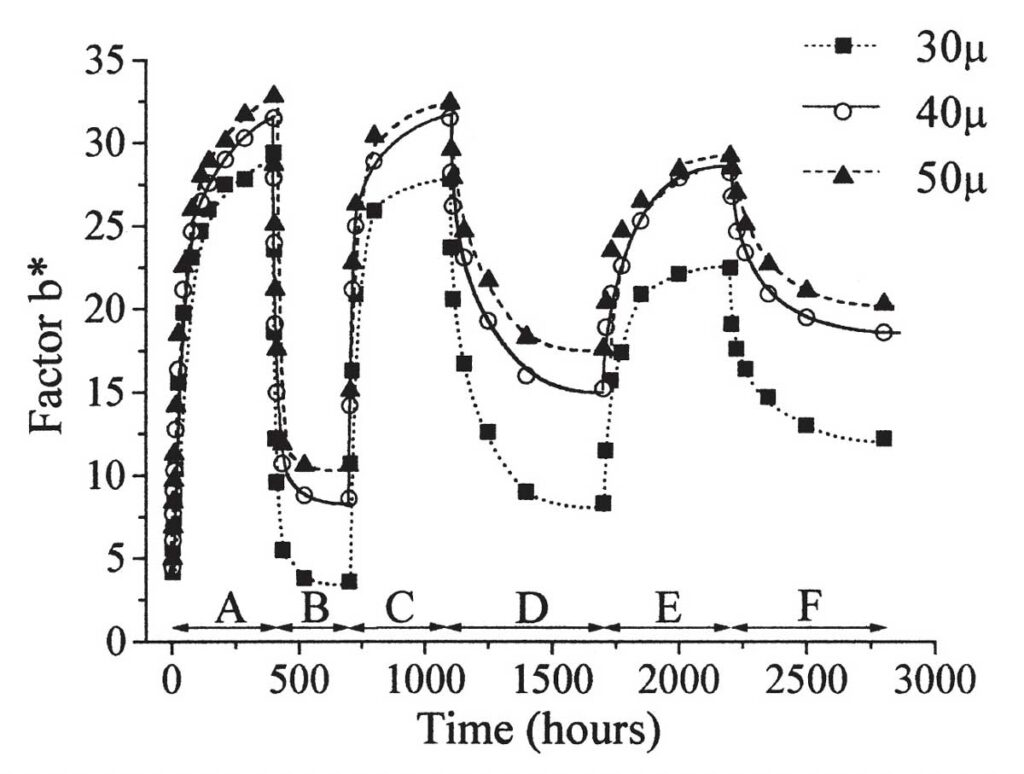
Thicker oil paint films are more prone to yellowing than thinner layers. Studies indicate that thick films retain more internal contaminants and unsaturated oxidation products, which contribute to persistent discoloration. While photo-oxidation can break down some yellowing compounds, the cross-linked structure of thicker films makes them less permeable to oxygen, slowing the bleaching effect. Over multiple thermo-oxidation and photo-oxidation cycles, residual yellowing in thick films remains more pronounced than in thinner films, which bleach more effectively when exposed to light (Mallégol et al., 2021, 128).
This graph shows how oil paint yellowing changes over time in three different film thicknesses (30μm, 40μm, and 50μm) as they go through cycles of heating (thermo-oxidation) and light exposure (photo-oxidation). The darker the paint becomes (higher factor b*), the more yellowing has occurred. The heating phases (A, C, E) cause the paint to yellow, while the light exposure phases (B, D, F) help reduce yellowing. Thicker paint layers (50μm) tend to hold onto yellowing more stubbornly, even after light exposure, while thinner layers (30μm) recover better. This means that using thinner layers of oil paint may help prevent long-term discoloration. (Mallégol et al., 2021, 128)
Why Linseed Oil Yellows More Than Other Drying Oils
Linseed oil is the most commonly used drying oil in oil painting due to its durability and strong film-forming properties, which contribute to its widespread preference despite its known tendency to yellow over time. However, it is also the most prone to yellowing. The high concentration of linolenic acid in linseed oil makes it particularly reactive to oxygen, leading to greater formation of yellowing compounds (Mallégol et al., 2001, 124). By contrast, poppyseed and safflower oils, which contain lower levels of linolenic acid, exhibit significantly less yellowing.
Fatty Acids
Linseed oil (%)
Poppy seed oil (%)
Walnut oil (%)
Safflower oil (%)
Palmitic acid (C16:0)
6–8
8–12
3–7
5.5–7
Stearic acid (C18:0)
3–6
2–3
0.5–3
2–3
Oleic acid (C18:1)
14–24
12–17
9–30
10–35
Linoleic acids (C18:2)
14–19
55–65
57–76
55–81
Linolenic acid (C18:3)
48–60
3–8
2–16
0–1
While linseed oil is indispensable for many painting techniques, artists should consider using poppyseed or safflower oil for whites and light tones. These oils yellow less but dry more slowly and form a weaker paint film. The trade-off between durability and color stability should guide an artist’s choice of medium depending on the painting’s intended longevity and use. However, using poppyseed or safflower oil in the underlayers of a painting may not be ideal due to their slower drying qualities, but since these layers are covered by others, yellowing may not be visible.
Want to read the full article and unlock all resources? Choose an option below:
Explore the process of paint film formation. This article demystifies the science behind the drying and film formation of artists’ acrylic and oil paints, offering insights into materials, techniques, and best practices for creating enduring artworks.
Explore how oil paint driers speed up drying times, the types available, and their long-term effects on paint durability. Learn to choose the best driers for your artwork.
Painting on wood panels? Learn how plywood, MDO, and HDO boards serve as durable supports. This guide covers stability, surface prep, pros & cons, and best practices for oil, acrylic, and tempera.
Excellent article. I really do read all your articles, George Hanlon, and appreciate your thoroughness and diligence. Question: How does walnut oil rank with yellowing of light colors?
Hi George,
I am hoping you will develop a poppyseed oil gel medium. I imagine it would be smooth as silk and non-yellowing. Oh how wonderful! And since many oil painters have a deep-seated fear of yellowing, I think it would sell well too!
Michele, remember that there is no such thing as a non-yellowing oil. All oils yellow regardless. We may consider creating a safflower oil medium. Poppy seed oil is rather costly.
Good practical approach, but I do have one comment: I take it that you believe that safflower (and poppyseed) oils weaker cross-linking isn’t a concern then — assuming they’re on the upper layers?
Safflower and poppy seed oils form significantly weaker films due to the composition of their fatty acids. Whether this concerns their use in the upper layers needs to be studied more. For this reason, we recommend their use sparingly and only where needed.
Fine-art photography often focuses on highlighting the aesthetics of the natural shape.
It is about composition rather than exposure.
Skilled photographers use natural tones to convey atmosphere.
Such images emphasize artistry and character. https://xnudes.ai/
Every shot aims to show emotion through pose.
The goal is to portray human beauty in an artful way.
Observers often value such work for its creativity.
This style of photography blends technique and aesthetics into something truly unique.
Report
There was a problem reporting this post.
Block Member?
Please confirm you want to block this member.
You will no longer be able to:
See blocked member's posts
Mention this member in posts
Invite this member to groups
Message this member
Add this member as a connection
Please note:
This action will also remove this member from your connections and send a report to the site admin.
Please allow a few minutes for this process to complete.
Report
You have already reported this .
Subscribe to Our Newsletter
To begin reading the content, join thousands of artists enjoying our articles. Subscribe to receive updates on artists materials and practices.


Excellent article. I really do read all your articles, George Hanlon, and appreciate your thoroughness and diligence. Question: How does walnut oil rank with yellowing of light colors?
Walnut oil yellows slightly less than linseed oil, but slightly more than poppy seed and safflower oils.
Hi George,
I am hoping you will develop a poppyseed oil gel medium. I imagine it would be smooth as silk and non-yellowing. Oh how wonderful! And since many oil painters have a deep-seated fear of yellowing, I think it would sell well too!
Michele, remember that there is no such thing as a non-yellowing oil. All oils yellow regardless. We may consider creating a safflower oil medium. Poppy seed oil is rather costly.
Good practical approach, but I do have one comment: I take it that you believe that safflower (and poppyseed) oils weaker cross-linking isn’t a concern then — assuming they’re on the upper layers?
Safflower and poppy seed oils form significantly weaker films due to the composition of their fatty acids. Whether this concerns their use in the upper layers needs to be studied more. For this reason, we recommend their use sparingly and only where needed.
I paint with a woman who was told in a community college that she could use canola oil. Is this really ok?
This is a big problem because canola oil is a non-drying oil.
Fine-art photography often focuses on highlighting the aesthetics of the natural shape.
It is about composition rather than exposure.
Skilled photographers use natural tones to convey atmosphere.
Such images emphasize artistry and character.
https://xnudes.ai/
Every shot aims to show emotion through pose.
The goal is to portray human beauty in an artful way.
Observers often value such work for its creativity.
This style of photography blends technique and aesthetics into something truly unique.