Explore the world of painting on copper with insights into materials, techniques, and preservation from studying historical paintings.
Painting on copper, a practice primarily seen from the 16th to the 18th centuries, presents a fascinating intersection of art and material science. Recent research by Daniel Vega, Isabel Pombo Cardoso, and Leslie Carlyle offers a detailed exploration of the materials and techniques used in these artworks. This study sheds light on historical practices and provides valuable information for contemporary artists interested in this unique medium.
Copper as a painting surface offers unique benefits, including durability and a smooth texture, which were highly valued by artists from the Renaissance onwards. However, the methods and materials used to prepare copper for painting are crucial to the artwork’s longevity and overall success. This article reviews the findings from a recent study focusing on the preparatory layers of copper paintings, offering artists practical insights and best practices derived from historical and analytical research.
The painting on the left is the Virgin Mary with Saint John and Child Jesus, a flamenco painting and copper support stamped by Peter Staas and attributed to the 17th century. Dimensions: 220mm × 170mm. The painting on the left is the Child Jesus, Savior of the World, a Portuguese painting adapted to an oval format on copper and attributed to the 18th century. Dimensions: 152mm × 109mm.
Author
Date
Title of the Work
Reference
References in Secondary Literature
A
B
C
D
E
F
Pacheco
1649
Arte de la Pintura, su Antiguedad y Grandeza
14
✓
✓
✓
✓
Anonymous
1656
Tractado del Arte de la Pintura
15
✓
Félibien
1676
Des Principes de l’Architecture, de la Sculpture, de la Peinture
16
✓
✓
✓
De La Fontaine
1679
L’Académie de la Peinture
17
✓
✓
Eikelenberg
1679
Aantekeningen over de schilderkunst
18
✓
Palomino
1724
El Museo Pictórico y la Escala Óptica
19
✓
✓
✓
✓
✓
De la Hire
1730
Oeuvres diverses de Mr de la Hire
20
✓
Pernety
1756
Dictionaire Portaif de Peinture, Sculpture et Gravure
21
✓
✓
✓
✓
Barrow
1758
Dictionarium Polygraphicum
22
✓
Dossie
1758
The Handmaid to the Arts
23
✓
✓
✓
✓
Hallen
1761
Werkstäte der Heutigen Künste, Oder die Neue Kunsthistorie
24
✓
De Piles
1766
Les Premiers Eléments de la Peinture Pratique
25
✓
✓
✓
✓
✓
Anonymous
1769
L’Ecole de la Miniature, ou L’art d’Apprendre a Peindre
26
✓
Griselini
1772
Dizionario delle Arti e de’ Mestieri
27
✓
Watin
1773
L’Art du Peintre, Doreur, Vernisseur
28
✓
✓
Anonymous
1777
Nieuwen Almanach Der Konst-schilders
29
✓
Dutens
1779
Principes Abrégés de Peinture
30
✓
Le Piler d’Appligny
1779
Traité des Couleurs Matérielles, et de la Manière de Colorer, Rélativement aux Diffèrens Arts & Métiers
31
✓
✓
Anonymous*
1793
The Golden Cabinet: Being the laboratory, or Handmaid of the Art
32
✓
Anonymous
1795
Encyclopädie für Künstler: Vollständiges Handbuch für Mahler und Lakirer (vol. II)
33
✓
* This artist’s manual was not considered in this study because it is an American publication.
There are at least 19 literary sources with information on various aspects of painting on copper: Secondary literature:
A – Bazzi, M., Notizie della Pittura su Metallo, Luigi Alfieri, Milano (1939).
B – Leegenhoek, I. ‘Les tableaux peints sur cuivre. Origine, constitution, conservation’, informe, Institut Française de Restauration des OEuvres d’Art, Paris (1986).
C – Spring, M. ‘A copy of the painting “Pan and Syrinx in Classical Landscape” by Martin Ryckaert from the Fitzwilliam Museum’, informe, Hamilton Kerr Institute, Cambridge (1991).
D – Horovitz, I., ‘The materials and techniques of European paintings on copper supports’ in Copper as Canvas: Two Centuries of Masterpiece Paintings on Copper, 1575-1775. Phoenix Art Museum, ed. M. Komanecky, Oxford University Press, New York, (1999) 63-92.
E – Schmid, A. ‘Silbrige metallüberzüge auf kupferbildträgern. untersuchungen zur materialität, applikationstechnik undfunktion anhand ausgewählter beispiele mit fokus auf adam elsheimers Frankfurter kreuzaltar’, tesina de master, Berner Fachnochschule (2013).
F – Stols-Witlox, M.J.N. ‘Historical recipes for preparatory layers for oil paintings in manuals, manuscripts and handbooks in North West Europe, 1550-1900: analysis and reconstructions’, tesis doctoral, Universiteit van Amsterdam (2014).
The Historical Context of Paintings on Copper
Copper plates began to be used as supports for easel paintings in the 16th century. This practice originated in Italy and quickly spread across Europe, particularly among Flemish artists. The technique’s popularity persisted into the 17th century and beyond, with examples found even in the 20th century. Copper’s rigid and non-absorbent surface allowed for fine detailing and vivid color retention, making it an attractive choice for artists.
Materials Used in Copper Paintings
The Copper Support
Artists historically sourced their copper plates from coppersmiths, ensuring the metal was well-polished and ready for use. Analytical studies have confirmed that the copper used in these artworks is of high purity, often exceeding 98%. The preparation of the copper surface involved thorough polishing and sometimes the application of an abrasive to enhance the adhesion of subsequent layers.
The Preparatory Layer
The preparatory layer ensures the paint adheres well to the copper surface. Historical texts and modern analyses reveal that this layer typically consisted of white lead (Spanish: albayalde) and other pigments bound in oil. The exact composition and application techniques varied, but standard practices included applying multiple thin layers and smoothing the surface with tools or even by hand.
Want to read the full article and unlock all resources? Choose an option below:
Painting on wood panels? Learn how plywood, MDO, and HDO boards serve as durable supports. This guide covers stability, surface prep, pros & cons, and best practices for oil, acrylic, and tempera.
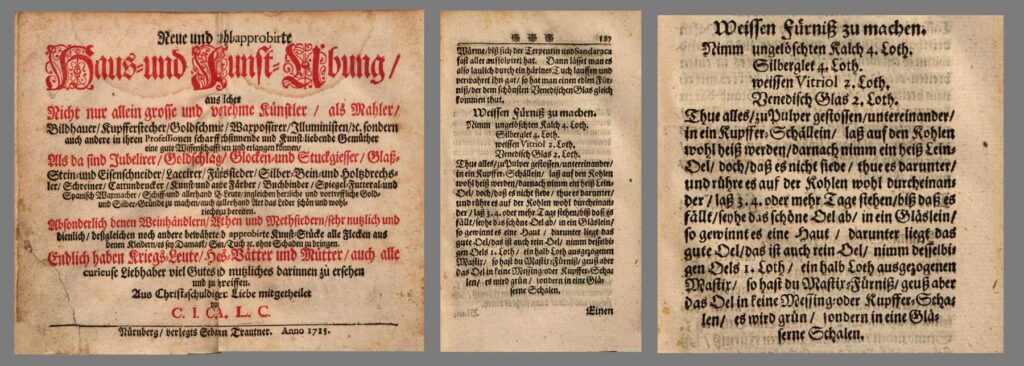
Explore historical oil painting siccatives, including lead oxide, alum, and Venetian glass. Learn how to prepare and use these traditional driers in painting.
Please note:
This action will also remove this member from your connections and send a report to the site admin.
Please allow a few minutes for this process to complete.
Report
You have already reported this .
Subscribe to Our Newsletter
To begin reading the content, join thousands of artists enjoying our articles. Subscribe to receive updates on artists materials and practices.





Responses