Understanding the materials we use is crucial for artists who want to create lasting works of art. The study of how pigments and other additives affect the drying process of oil paints has a direct impact on the techniques and outcomes of our artwork. A recent study, Unravelling the Effect of Carbon Black in the Autoxidation Mechanism of Polyunsaturated Oils, delves into the intricate effects of carbon black, a commonly used pigment, on the curing of oil paints. This review aims to summarize the study’s key findings and provide practical insights for artists, especially those using carbon black pigments like lamp black.
Lamp Black Oil Paint and Its Effect on Drying Time
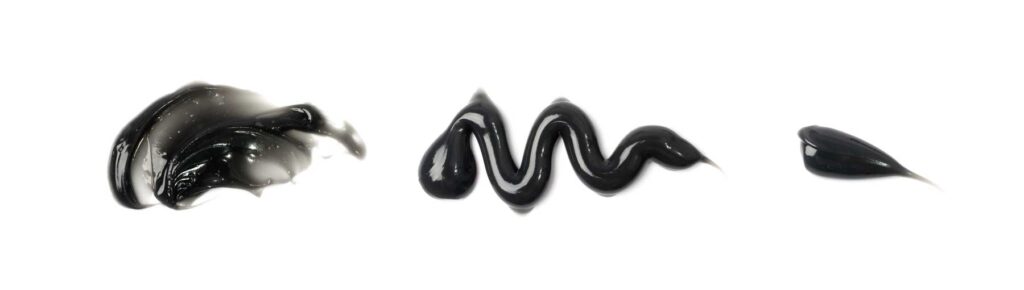
Carbon black, particularly in the form of lamp black, is known for its deep, rich black color. However, it significantly affects the drying time of oil paints. The study confirms that carbon black slows down the autoxidation process in linseed oil, the primary binder in most oil paints. This delay is due to carbon black’s antioxidant properties, which inhibit the formation of peroxides, critical components in the drying and hardening process of oils.
For artists, this means that while carbon black provides intense color saturation, it may extend the drying time of the paint, making it important to account for longer waiting periods between layers or consider the use of drying agents.
How Zinc Stearate and Aluminium Stearate Affect Oil Paint Curing
The study also investigated the effects of common additives—aluminum stearate and zinc stearate—on the curing of carbon black oil paints. These metal stearates are frequently added to oil paint formulations to enhance pigment dispersion and adjust the paint’s body and texture. Interestingly, both additives accelerated the initial stages of the curing process. Zinc stearate, in particular, significantly increased the formation of peroxides in the first month of drying, suggesting a quicker but more intense drying phase. After this period, the curing process slowed, with active radicals and peroxides remaining even after 12 months.
Artists using carbon black paints with these additives should be aware of these accelerated drying phases and adjust their techniques accordingly, perhaps allowing for shorter intervals between applications but anticipating slower full curing times in the long term.
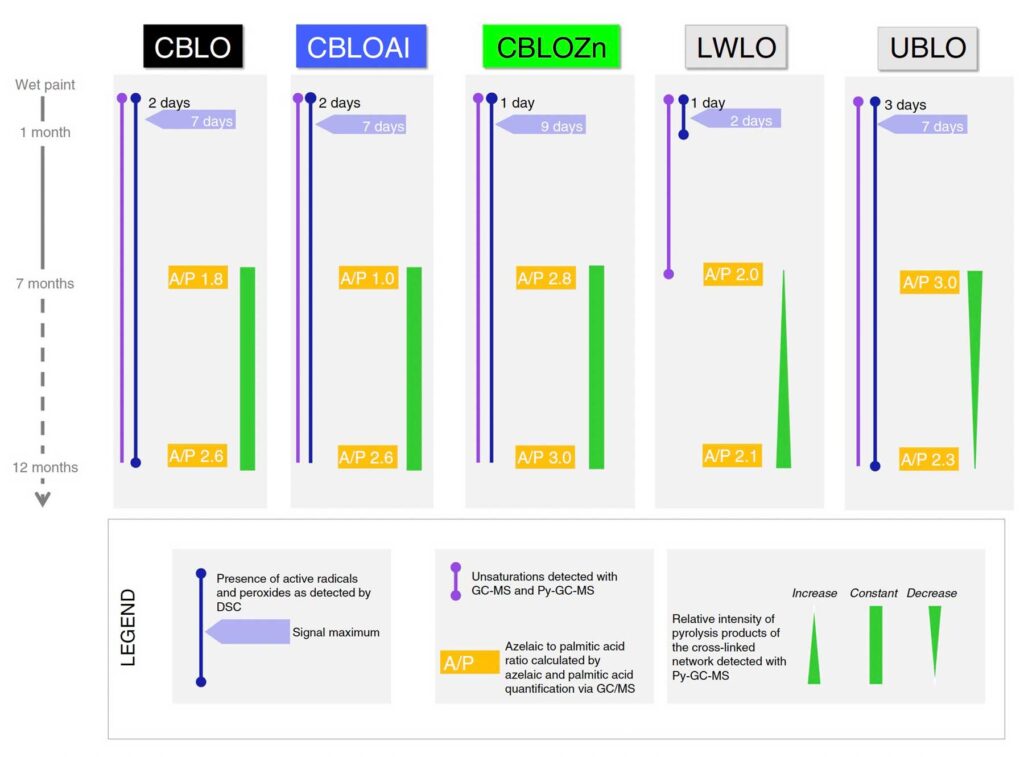
This is a summary of the present study’s drying time of lamp black and a comparison with lead white/linseed oil (LWLO) and ultramarine blue/linseed oil (UBLO) paint. Data from LWLO and UBLO up to seven months have been reported in another publication, while data at 12 months of natural aging are from the present study.
Abbreviations used in the Study
CBLO—Carbon black in linseed oil
CBLOAl—Carbon black in linseed oil with aluminum stearate
CBLOZn—Carbon black in linseed oil with zinc stearate
LWLO—Lead white in linseed oil
UBLO—Ultramarine blue in linseed oil
Comparing Lamp Black to Other Pigments in Oil Paint Drying
The study contrasts the effects of carbon black with other pigments, including lead white and ultramarine blue. Lead white, a known drying agent, accelerates the curing process, while ultramarine blue, like carbon black, slows it down. The systematic mass loss in carbon black-based paints, observed over time, was attributed to the evaporation of low molecular weight degradation products. This was not found in lead white paints, where fatty acids bind with lead to form stable metal soaps, preventing significant evaporation.
Want to read the full article and unlock all resources? Choose an option below:
Explore how essential oils like lavender, clove, and thyme improve oil painting drying times and color retention. Learn practical applications for artists.
Painting on wood panels? Learn how plywood, MDO, and HDO boards serve as durable supports. This guide covers stability, surface prep, pros & cons, and best practices for oil, acrylic, and tempera.
Great article! Not knowing this information one would tend to use lamp Black like ivory black and greatly jeapordize the structure of the paint film. Thanks again George!
Report
There was a problem reporting this post.
Block Member?
Please confirm you want to block this member.
You will no longer be able to:
See blocked member's posts
Mention this member in posts
Invite this member to groups
Message this member
Add this member as a connection
Please note:
This action will also remove this member from your connections and send a report to the site admin.
Please allow a few minutes for this process to complete.
Report
You have already reported this .
Subscribe to Our Newsletter
To begin reading the content, join thousands of artists enjoying our articles. Subscribe to receive updates on artists materials and practices.





Great article! Not knowing this information one would tend to use lamp Black like ivory black and greatly jeapordize the structure of the paint film. Thanks again George!