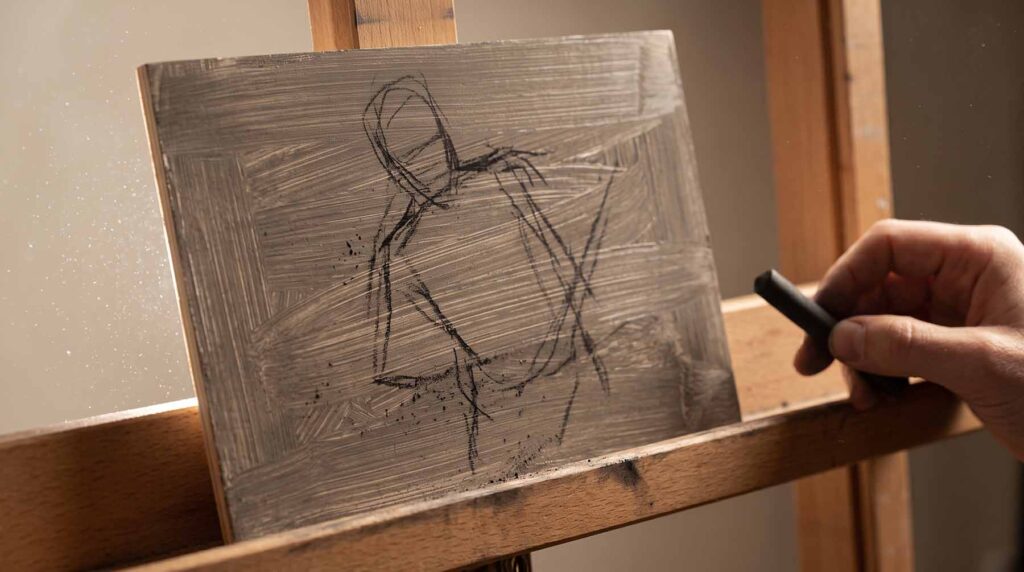
Imprimatura oil painting is the term for a habit many painters already have: toning a blank canvas or panel before the real work starts. Rubens reached for that same instinct four hundred years ago. But the layer behind his Achilles sketches turns out to be far more engineered than “toned ground” suggests.
Chalk, egg, and oil haven’t changed much since his time, either. That makes this a technique worth putting to work today, not just a historical curiosity.
Rubens’ Achilles series holds seven of his eight surviving oil sketches for the project at the Museum Boijmans van Beuningen. The eighth is in the Detroit Institute of Arts. A 2007 cross-section study of four of those sketches found his streaky gray imprimatura was neither glue size nor oil paint. It was an egg-oil emulsion, and he drew directly into it while it was still workable. That combination is very likely why lines he drew nearly four centuries ago have survived intact, without a trace of fixative, through every conservation treatment these panels have undergone since.
Why This Paper Matters
Rubens painted fast. His Achilles series—eight oil sketches in all, made around 1630–1635 as design studies for a set of tapestries—still carries the evidence of that speed. Seven of the sketches, held together at the Museum Boijmans van Beuningen, show loose black lines, patches of bare ground, and a restless gray-brown underlayer showing through everywhere. For a long time, that underlayer was simply called an imprimatura and left at that.
A 2007 study by Annetje Boersma, Annelies van Loon, and Jaap Boon went further. It was published through the University of Amsterdam’s molecular painting-science program. Using cross-sections, SEM-EDX, FTIR, and DTMS on four of the seven Boijmans panels, the team asked a simple studio question: what, exactly, was Rubens painting and drawing on top of? The answer turned out to be unexpectedly complicated.
The answer matters to any painter who tones a ground, draws on top of it, and then paints over that drawing without losing it. It also matters to anyone curious about imprimatura oil painting more generally. Rubens’ streaky gray imprimatura turns out to be neither a simple oil isolation layer nor a conventional glue size.



Responses