Shipping paintings requires meticulous care and technical insight to prevent damage. To ship a painting safely, treat it as a composite structure that is sensitive to both physical forces and environmental change in transit. Professional guidelines developed by conservation scientists and museums emphasize evidence-based methods to mitigate risks such as shock, vibration, temperature extremes, and humidity fluctuations (Richard et al. 1997, 16). This review consolidates best practices for packing and transporting canvas and panel paintings, drawing on key research from Art in Transit (1991, 1997), the Getty Conservation Institute, and the PROPAINT project (2010). We address recommendations for unframed and large-scale works, rolled paintings, glazed pieces, and artworks with fragile surfaces. The goal is to translate conservation-backed findings into practical, step-by-step shipping procedures that professional artists can apply. All advice is grounded in technical evidence and focuses on materials and methods that genuinely protect art in transit.
Understanding Transit Damage Mechanisms When You Ship a Painting
Shock and Impact: Sudden jolts or drops can crack paint, tear canvases, or dent panels. In transit, handling accidents (falls, collisions) can produce high-G-force impacts that are especially dangerous. Research shows that improper packing can transmit nearly the full shock to the painting if cushioning is inadequate or overloaded (Marcon 1991, 123). Even a short drop (e.g., 30 inches) can subject a crate to dozens or hundreds of g’s of deceleration, potentially causing stretcher bars to strike the canvas or brittle paint to flake (Mecklenburg 1991). Effective packing must absorb and dissipate shock forces before they reach the artwork (Marcon 1991, 124). This is a prime rationale for using thick foam padding and rigid internal supports, as discussed below.
Vibration: Continuous low-level vibration from vehicle engines and road/rail travel can induce fatigue or wear over time, though it is generally a lesser threat than sudden shocks (Hackney and Green 1991, 69). Typical transport vibrations are random and usually low in amplitude. However, if a painting or its components resonate at certain frequencies, even small vibrations could loosen joints, fasteners, or surface particles (Mecklenburg et al. 1991). For example, vibration can dislodge keys (wedges) from a stretcher or cause a slack canvas to slap against the stretcher bar, leading to abrasion or paint loss (Richard et al., 1997, 31). Laboratory tests have found that a stretched canvas primarily vibrates in a direction perpendicular to its plane, which “explains the common practice of transporting paintings on stretched canvas vertically” (Hackney & Green 1991, 75). In other words, shipping a painting upright (as it hangs) minimizes the most harmful vibration mode. Even so, prudent shippers further reduce the risk of vibration by using cushioning foam and securing all loose components. As a precaution, any object attached to a painting (e.g., ornamentation on a frame or mixed-media elements on a canvas) should be tightly fastened or removed, since vibration can cause unsecured pieces to rub or detach (Richard et al. 1997, 82).
Environmental Fluctuations: Changes in temperature and humidity during transit can be as damaging as physical forces. Paintings are composites of materials (wood, canvas, paint, ground, adhesives) that expand and contract at different rates when conditions change. Temperature extremes are dangerous: paint films become more brittle in cold conditions and more prone to deformation in high heat (Richard et al. 1997, 27). For instance, oil paint and acrylic polymers stiffen at low temperatures, increasing the risk of stress-induced cracks, while aged linings or adhesives may soften and creep at elevated temperatures. Moreover, temperature fluctuations drive humidity changes within the packaging. If the air around a painting cools, relative humidity (RH) rises, potentially reaching the dew point and causing condensation; if it heats up, RH drops and desiccates the materials. Rapid RH shifts can lead to warping of wood panels, loosening of canvas tension, cleavage of paint from the ground, and other moisture-related damage. Panel paintings are especially vulnerable—without moisture control, they can warp or crack when moved from a stable gallery climate into uncontrolled transit conditions (Dahlin 2010). For canvas paintings, even short-term exposure to very low RH can make the canvas fibers brittle, and shrinkage can cause new tears along tacking edges or cupped paint to flake (Mecklenburg et al. 1991). Thus, maintaining a moderate, stable climate around the artwork during shipping is critical. Research by the National Gallery of Art has demonstrated that well-designed packing cases can significantly “retard changes in temperature and relative humidity,” protecting the art until it returns to a controlled environment (Merrill 1991).
Protective Packing Systems for Paintings
Successfully shipping a painting means creating a protective “micro-environment” around it that buffers against shocks and climate swings. There is a spectrum of packing methods, from simple soft wraps to sophisticated climate-controlled crates. Below, we review the options and evidence-based recommendations:
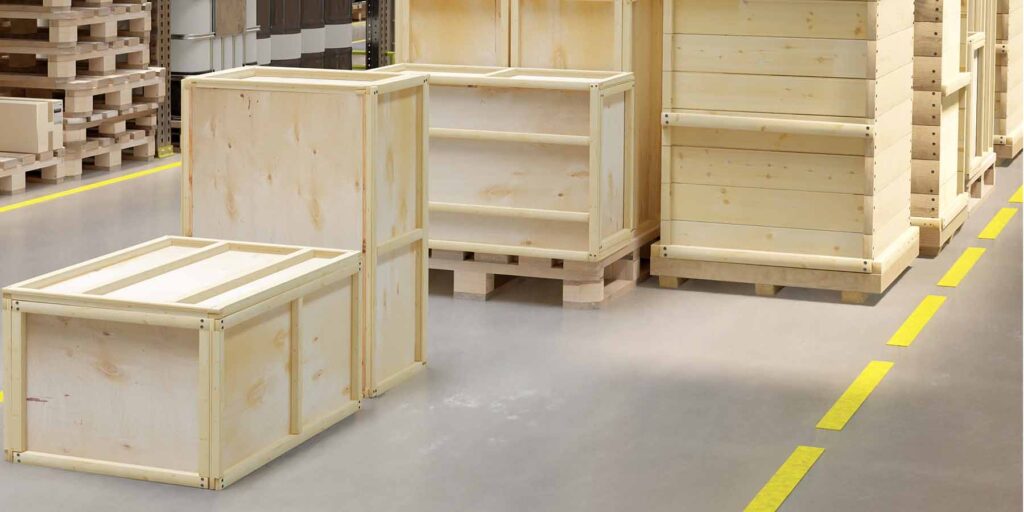
“Soft Packing” vs. Crating: In some situations, especially short local moves, paintings are shipped without a wooden crate—for example, wrapped in layers of padding and placed in a sturdy cardboard carton. This “soft packing” is economical and lightweight but offers minimal protection. Conservation experts strongly caution against soft-packing for transport beyond local or short-distance distances (Richard et al., 1997, 128). The consensus is that soft wrapping lacks the insulating and shock-absorbing capacity needed for long-distance or commercial shipments. Even when a climate-controlled van is used, a painting wrapped only in plastic and foam is vulnerable to temperature fluctuations during loading or unloading in extreme weather and offers little protection against impacts or punctures during handling (Richard et al., 1997, 128). For these reasons, museums and conservators “resist the attraction…of reduced cost through soft-packed shipments”, except perhaps for short trips across town (Richard et al. 1997, 128). The recommended practice is to use a rigid shipping crate for any shipment of valuable or long-distance goods.







Great article. But, wish there was a visual for a “Travel Frame”, similar to figure 1.
We will work on adding a diagram of a travel frame to this article.
Thanks, that would be a great help. Am a little confused by the text (maybe am overthinking this! 🙂
I too would appreciate a clear visual for a travel frame. Thanks!