In the ever-evolving world of art, materials and techniques are at the heart of every painting. For contemporary painters, the choice of canvas is as crucial as the brush strokes they apply. Anne Carter and her team, in their paper “Investigating Commercially Primed Contemporary Artist Canvases,” meticulously analyze the materials used in commercially primed canvases. This review highlights their findings and offers practical insights for artists.
Commercially primed canvases are common supports for contemporary painters. Such canvases are convenient and often affordable. However, the product information available for artists to inform purchase choice or their aging characteristics is limited and often unavailable.
The Study’s Scope and Methodology of Commercially Primed Canvases
The study analyzed fifty-three commercially primed canvases from Australian and Singaporean suppliers. The canvases, representing nineteen brands, underwent rigorous testing to identify their fiber, priming binder, pigments, and fillers. These tests included optical microscopy, ATR-FTIR, Py-GCMS, XRF, Raman spectroscopy, and SEM-EDS, among others.
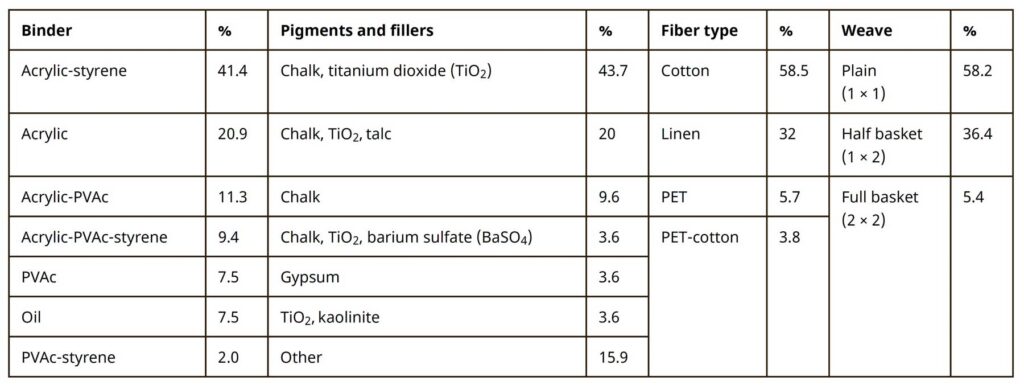
Summary of priming materials of 53 commercially primed canvases based on ATR-FTIR analysis and optical microscopy.Cross sections in visible light of (a) Artfix polyester canvas with single priming layer of PVAc (VeoVa)–acrylic (BA-MMA)–styrene with titanium white, chalk, and talc. (b) Caravaggio linen canvas with double priming layers; top: acrylic (EA-EHA-EMA-MMA) with titanium white (no chalk); bottom: styrenated acrylic (EA-MMA) with kaolinite. (c) Sydney Canvas Company cotton canvas with single priming layer of acrylic (BA-MMA)–PVAc with chalk and titanium white. (d) Phoenix cotton canvas with double priming layers. Surface: styrenated acrylic (ATR-FTIR). All: BA-MA-MMA-styrene-PVAc (Py-GCMS). Images: Queensland Art Gallery, Gallery of Modern Art, Australia, and Heritage Conservation Centre (National Heritage Board), Singapore
Findings on Priming Materials
Synthetic Polymers and Their Prevalence
The study revealed that synthetic polymers are predominant in contemporary commercially primed canvases. Of the fifty-three samples, forty-nine contained synthetic polymer binders. Styrenated-acrylic was the most common, followed by acrylic and acrylic-PVAc binders. The presence of these materials reflects a shift from traditional oil-based primers to synthetic alternatives, largely due to their cost-effectiveness and versatility.
Variability in Priming Layers of Commercially Primed Canvases
The analysis identified four primary priming stratigraphies. These varied from single layers of irregular thickness to multiple layers with varying compositions. Notably, thirty-two percent of samples had single priming layers, while the rest exhibited double layers with combinations such as acrylic over styrenated acrylic or oil over acrylic-PVAc. This variability highlights the lack of standardization in the production of commercially primed canvases.
Impact on Conservation and Longevity
Sensitivity to Environmental Conditions
One significant finding was the sensitivity of these primed canvases to environmental conditions. Some exhibited stretchiness, discoloration, and unpredictable responses to humidification and heat. This has profound implications for conservation, as these materials may not withstand traditional conservation treatments. The presence of styrene, in particular, raises concerns due to its instability under UV radiation, which can lead to yellowing and cracking.
Want to read the full article and unlock all resources? Choose an option below:
Painting on wood panels? Learn how plywood, MDO, and HDO boards serve as durable supports. This guide covers stability, surface prep, pros & cons, and best practices for oil, acrylic, and tempera.
Water gilding gesso and bole, decoded from Portuguese Baroque treatises and laboratory reconstruction. Practical guidance for artists who want recipes that work.
Please note:
This action will also remove this member from your connections and send a report to the site admin.
Please allow a few minutes for this process to complete.
Report
You have already reported this .
Subscribe to Our Newsletter
To begin reading the content, join thousands of artists enjoying our articles. Subscribe to receive updates on artists materials and practices.








Responses