The enduring beauty of Old Masters’ paintings has long captivated audiences and artists alike. A crucial yet underexplored aspect of their craft lies in the materials and techniques they used. A recent study published in Nature Communications delves into the use of egg yolk in oil paints, offering a detailed scientific and artistic perspective on how this ingredient enhanced the rheological properties, stability, and longevity of their works. This exploration not only sheds light on historical practices but also provides modern artists with insights into leveraging similar methods in contemporary painting.
Historical Context and the Mystery of Egg Yolk
The use of egg yolk in oil paints was a sophisticated innovation, combining the fluidity and versatility of oil with the stabilizing and protective properties of proteins. This practice was particularly common among Renaissance artists such as Botticelli and Leonardo da Vinci, who sought to refine the relatively new medium of oil paint to suit their complex artistic visions. Historical records and modern analyses of Old Masters’ paintings reveal that egg yolk was likely added to oil paints to address challenges related to texture, drying behavior, and environmental stability.
One of the study’s key findings is that egg yolk significantly alters the behavior of oil paints. The researchers demonstrated that yolk enhanced brushability, allowed for intricate impasto effects, and improved resistance to environmental conditions. These qualities made it possible for artists to create works that balanced expressive detail with durability.
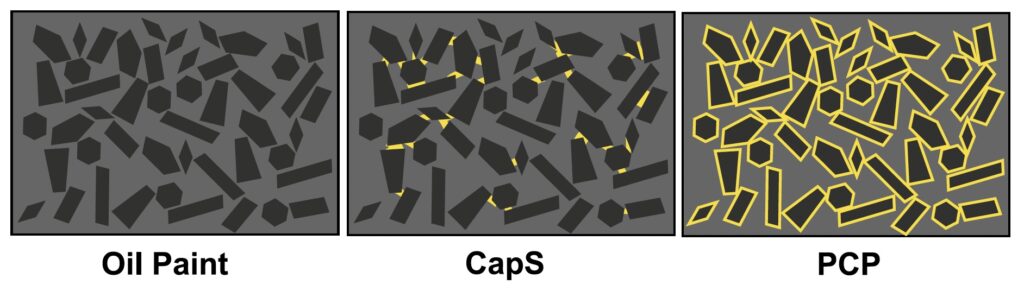
Microstructure of Paints: Oil paints are composed of pigments combined with linseed oil, creating a uniform mixture. A capillary suspension (CapS) is a variation of this, made by adding a small amount of egg yolk to the oil-pigment mixture and blending it thoroughly. This addition induces the formation of an interconnected pigment particle network, significantly increasing the paint’s stiffness. In contrast, a protein-coated pigment (PCP) is prepared by mixing pigment with a diluted egg yolk solution and then drying. Once the water evaporates, the pigment particles are coated with a thin layer of egg yolk. These coated particles are ground and mixed with oil to produce the final paint. This illustration by the authors of the study shows the paint’s microstructure. The pigments are represented in black, the oil is in gray, and the egg yolk is in yellow.
Scientific Insights of Egg Yolk from Modern Reconstructions
To understand the role of egg yolk in Old Masters’ oil paints, researchers recreated paint formulations using linseed oil, egg yolk, and synthetic pigments like ultramarine blue and lead white. These experiments focused on two approaches: capillary suspension (CapS) paints, where egg yolk was mixed directly into the oil, and protein-coated pigments (PCP), where pigments were pre-coated with a thin layer of egg yolk before being mixed with oil.
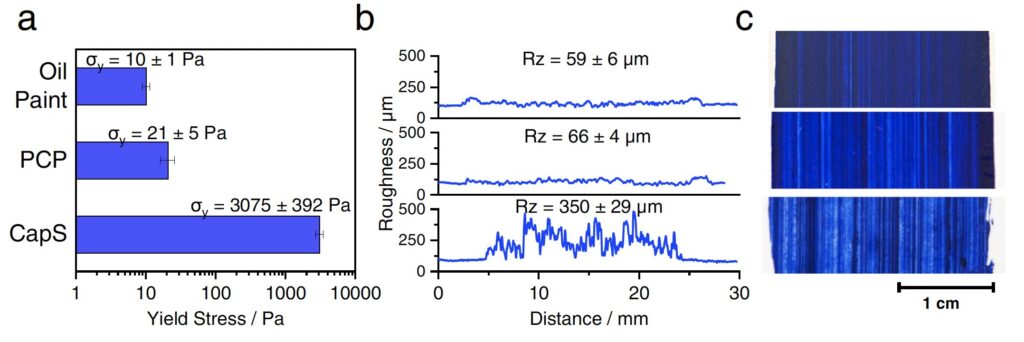
Yield Stress and Brushstroke Characteristics in Ultramarine Paints: Yield stress refers to the minimum force required for a material, such as paint, to begin flowing. For paints, yield stress is crucial in determining how easily the paint can be applied with a brush and how it holds its shape once applied. The study examines the relationship between the yield stress (σy), the surface roughness (Rz), and the appearance of brushstrokes. Paints were formulated with a pigment volume concentration (PVC) of 32%, and the two egg yolk variants included 2% egg yolk solids. Higher yield stress values indicate stiffer paints that resist flow, influencing the texture and control during application. The data highlights differences in brushability and texture between the protein-coated pigment (PCP) paints and capillary suspension (CapS) paints. The CapS paints are the stiffest to brush out and retain more brushstrokes.
The rheological properties of these formulations were compared to pure linseed oil paints, revealing striking differences. Pure linseed oil paints exhibited low yield stress, which made them smooth and easy to apply but prone to leveling after brushstrokes. In contrast, CapS paints, where egg yolk acted as a secondary fluid phase, displayed a dramatic increase in yield stress. This higher yield stress preserved brushstroke profiles and enabled the creation of thick, textured layers characteristic of impasto. PCP paints, on the other hand, achieved a balance between the smoothness of pure linseed oil paints and the structural stability of CapS paints. This balance was achieved because the yolk coating on pigments minimized the formation of capillary networks that could stiffen the paint excessively.
Drying Dynamics and Oxidative Stability
Drying time, a critical factor for any artist, also varied significantly between the formulations. Linseed oil alone required up to 70 days to form a solid layer in standard conditions, a time reduced to 20 days when pigments like lead white were added. However, the inclusion of egg yolk delayed the drying process, extending the time needed for CapS and PCP paints to form stable films. This delay was attributed to the antioxidant properties of yolk proteins, which slow the oxidative reactions central to the curing of linseed oil.
Want to read the full article and unlock all resources? Choose an option below:
Painting on wood panels? Learn how plywood, MDO, and HDO boards serve as durable supports. This guide covers stability, surface prep, pros & cons, and best practices for oil, acrylic, and tempera.
I would have liked to hear how we could practically incorporate this into our own paints and practice.
As well as how long it actually takes to dry relative to regular linseed oil bound paints.
It seems useful and I know of a couple of artists who use it (from the web) but I’m not sure that they’re incorporating it properly.
For all the times I’ve tried it it’s been with an emulsion and it can be easily failed. And when it works it seems to cause the paint to dry quite quickly. Maybe within 5-30 minutes? Ofc I imagine the actual curing process would take several days but essentially for all intents and purposes the paint becomes “dry” (/no longer workable after that timeframe of 5-30 mins).
Not sure what to make of this except to think that there might be other ways to incorporate or formulate the egg yolk into the paint.
Report
There was a problem reporting this post.
Block Member?
Please confirm you want to block this member.
You will no longer be able to:
See blocked member's posts
Mention this member in posts
Invite this member to groups
Message this member
Add this member as a connection
Please note:
This action will also remove this member from your connections and send a report to the site admin.
Please allow a few minutes for this process to complete.
Report
You have already reported this .
Subscribe to Our Newsletter
To begin reading the content, join thousands of artists enjoying our articles. Subscribe to receive updates on artists materials and practices.


Very interesting ! Thanks for posting this article.
I would have liked to hear how we could practically incorporate this into our own paints and practice.
As well as how long it actually takes to dry relative to regular linseed oil bound paints.
It seems useful and I know of a couple of artists who use it (from the web) but I’m not sure that they’re incorporating it properly.
For all the times I’ve tried it it’s been with an emulsion and it can be easily failed. And when it works it seems to cause the paint to dry quite quickly. Maybe within 5-30 minutes? Ofc I imagine the actual curing process would take several days but essentially for all intents and purposes the paint becomes “dry” (/no longer workable after that timeframe of 5-30 mins).
Not sure what to make of this except to think that there might be other ways to incorporate or formulate the egg yolk into the paint.