New Molecular Research Connects a Specific Pigment to Studio Practice
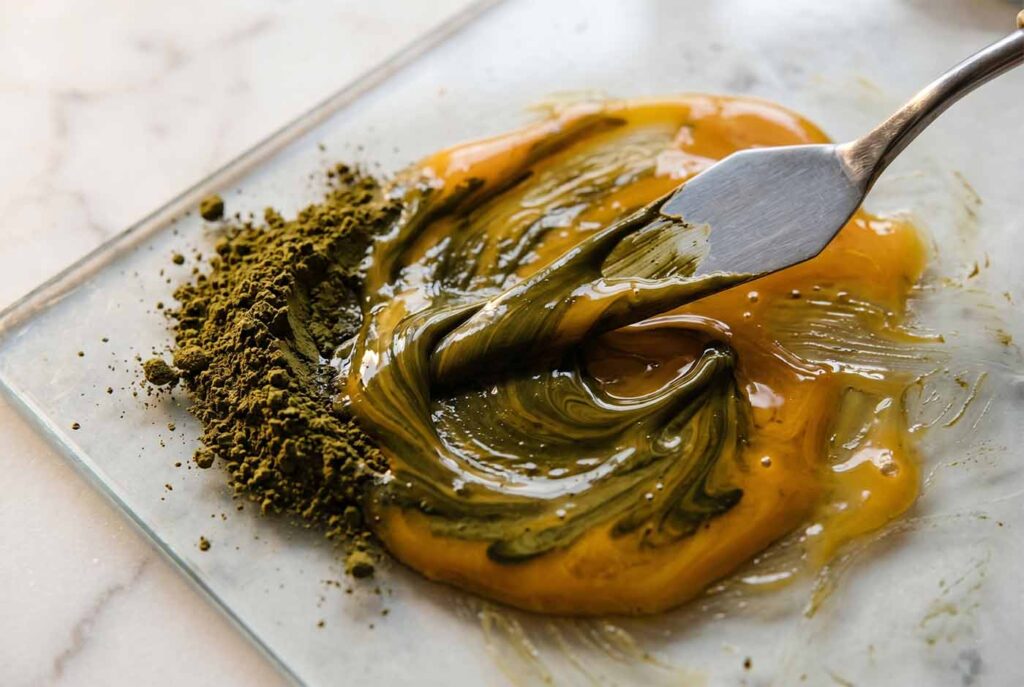
For centuries, painters have known that egg tempera technique is unlike any other medium. It stiffens on the brush, builds in precise, luminous layers, and dries to a film that has survived 600 years on panel. Yet until recently, no one had examined why at the molecular level — or why certain pigments work so much better in this medium than others. A 2022 paper in Angewandte Chemie International Edition — by Agathe Fanost, Maguy Jaber, and colleagues at Sorbonne Université — finally closes that gap.
Using two complementary techniques, rheology and NMR relaxometry, the team probed egg tempera paint at every scale from the individual molecule to the brushstroke. Their specific subject was green earth pigment (terra verde) dispersed in egg yolk — formulated from 15th-century recipes in Cennino Cennini’s Il Libro dell’Arte (Fanost et al., 2022, p. 1). What they found explains not just how egg tempera behaves, but why green earth in particular produces such a stable, responsive, and historically durable paint. The results have direct implications for any artist working with this medium today.
What Is Egg Yolk in Egg Tempera, Really?
Before understanding why the paint behaves as it does, it helps to know what you are actually putting on your palette. Egg yolk is not a simple liquid. It is a complex biological emulsion composed of roughly 51% water, 30.7% lipids, 16% proteins, 1.7% minerals, and 0.6% carbohydrates (Fanost et al., 2022, p. 1, citing Anton 2007). The lipids and proteins don’t float freely — they exist as lipoproteins, large molecules in which fatty components are wrapped in protein coats. These lipoproteins are the key players in what happens when yolk meets pigment.
Water serves as the diluent that makes the paint fluid enough to brush. However, as the science shows, water in egg tempera is not passive. It actively participates in the molecular network that gives the paint its remarkable handling characteristics.
Green Earth: An Ideal Pigment for Egg Tempera Technique
Green earth — terra verde in Italian, composed primarily of celadonite or glauconite — is a phyllosilicate mineral of the mica family. Its layered platelet structure gives it two distinct surfaces: flat basal faces and reactive edge sites (Fanost et al., 2022, p. 3). Cennino Cennini praised it as suitable for virtually any application in fresco, secco, and panel work, and noted its stability and low cost (Fanost et al., 2022, p. 1). Historically, it was used as an underpainting for flesh tones in Italian medieval painting. The new research explains, for the first time, exactly why this pigment works so exceptionally well with egg yolk.
The celadonite mineral contains significant amounts of iron(III), which is paramagnetic — a property the researchers used as a molecular probe (Fanost et al., 2022, p. 2). Meanwhile, its edge surfaces carry a particular chemical reactivity that turns out to be crucial for the paint’s structure.





Responses