Oil painting on wood requires careful preparation because wood expands and contracts with humidity and wicks the binder into its pores. This article reviews a short paper by Anne‑Marie Olsson and Dick Sandberg on how wood and high‑solid linseed oil paint interact. It translates Olsson and Sandberg’s measurements into studio practice: why dispersive forces—not chemical fusion—govern adhesion; how capillarity causes early sink‑in; and why hardwood panels outperform softwoods. You’ll learn to select stable hardwood substrates, seal face, edge, and end grain (front and back), and lay an oil ground that limits binder loss and moisture‑driven damage.
How the study was done
The authors measured contact angles of probe liquids placed on linseed oil films on glass and on Scots pine, before and after drying. They used water, formamide, ethylene glycol, and diiodomethane, and applied a Young–Dupré acid–base model to split the surface energy into dispersive and polar components. In their terms, “high‑solid” paint is linseed‑oil paint with minimal solvent that dries by oxidation. These measurements frame adhesion behavior relevant to oil painting on wood.
What the study found
Apolar forces dominate adhesion
Wood and linseed oil share a strong dispersive component and only a small polar part. Water is different; it has low dispersive energy and strong polarity. Therefore, water can disrupt the small polar part of oil–wood adhesion but not the larger dispersive part. This balance supports stable adhesion for oil painting on wood.
Work of adhesion: oil–wood vs water–wood
The work of adhesion is about 80 mJ/m² for linseed oil on wood and about 120 mJ/m² for water on wood. Oil binds well, even though water binds more strongly in that metric. After curing, dispersive interactions still do most of the work. This is significant for oil painting on wood in variable humidity.
Contact angle behavior reflects penetration into wood
On undried wood, the contact angle of dried oil paint falls quickly over seconds as oil penetrates; on glass, where no penetration occurs, the angle remains steady. After drying, wood and glass values converge. This supports the idea that penetration drives the early change. This matters when planning first coats for oil painting on wood.
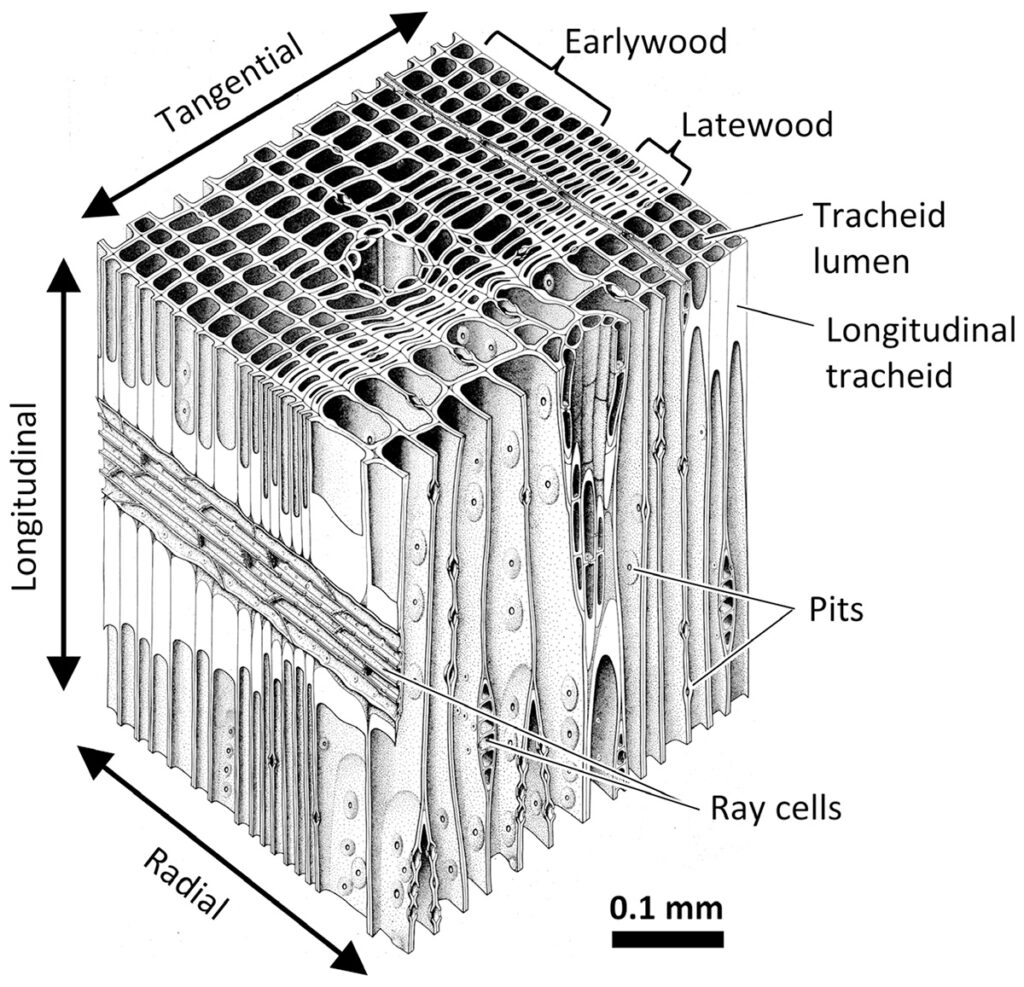
The tracheid lumen (plural: lumina) and pit openings provide the pathways through which oil and other liquids are absorbed into the wood.
Wood structure governs penetration
Whole oil molecules are too large to slip between cellulose chains. However, they move through lumina and pit openings. Therefore, capillary flow in these features controls uptake more than diffusion into the cell wall. Understanding these pathways is central to sizing and priming for oil painting on wood.
Want to read the full article and unlock all resources? Choose an option below:
Painting on wood panels? Learn how plywood, MDO, and HDO boards serve as durable supports. This guide covers stability, surface prep, pros & cons, and best practices for oil, acrylic, and tempera.
Explore historical oil painting siccatives, including lead oxide, alum, and Venetian glass. Learn how to prepare and use these traditional driers in painting.
George, thank you for the time you devote to continuous education.
What about more information on painting with water-soluble paints and ink on wood? The Japanese have been doing it very successfully for a long time, but it’s hard to get info from them. Any help with the technical approach (materials, recipes, proportions, procedure)would be much appreciated.
Thank you
simon
This is not something I can promise right away, but if it is possible and you subscribe, you will get a notice.
Report
There was a problem reporting this post.
Block Member?
Please confirm you want to block this member.
You will no longer be able to:
See blocked member's posts
Mention this member in posts
Invite this member to groups
Message this member
Add this member as a connection
Please note:
This action will also remove this member from your connections and send a report to the site admin.
Please allow a few minutes for this process to complete.
Report
You have already reported this .
Subscribe to Our Newsletter
To begin reading the content, join thousands of artists enjoying our articles. Subscribe to receive updates on artists materials and practices.





George, thank you for the time you devote to continuous education.
What about more information on painting with water-soluble paints and ink on wood? The Japanese have been doing it very successfully for a long time, but it’s hard to get info from them. Any help with the technical approach (materials, recipes, proportions, procedure)would be much appreciated.
Thank you
simon
We’ll look into this. I am familiar with some of the processes.
Thank you, George! Looking forward to reading it.
Is there a way to get a notification? Would hate to miss it.
This is not something I can promise right away, but if it is possible and you subscribe, you will get a notice.