Oil Paint Driers: Why This Research Matters to Artists
Painters often reach for oil paint driers when a painting is taking too long to set, when a commission deadline is close, or when one passage dries so much more slowly than another that the whole work becomes awkward to manage. That decision can feel practical and harmless. A few drops promise a quicker surface, easier overpainting, and less waiting. However, the chemistry behind that decision is more consequential than many artists realize.
The paper by Silvia Pizzimenti and colleagues examines what happens when selected metal-based driers are added to a modern commercial oil paint based on alkali-refined linseed oil and cadmium red pigment. The study is technically sophisticated, but its core question is one that artists face in the studio: when you accelerate drying, what else are you changing in the paint film? The answer is not simply that the paint dries faster. Rather, the drier can change where curing starts, how evenly the film polymerizes, how long reactive species remain in the paint, and how stiff the paint layer becomes over time (Pizzimenti et al. 2025, pp. 465–475).
This matters because the oil painter is not merely trying to make wet paint become dry to the touch. The painter is trying to build a film that remains coherent, reasonably flexible, and durable over many years. A drier can help with workflow, but it can also introduce a new set of problems: premature skinning, wrinkling, undercured lower layers, brittleness, gloss differences, and uncertainty about how much to add. In practice, dosing is one of the most difficult parts of using driers well. The margin between “too little to matter” and “enough to create new defects” can be narrow. Therefore, artists who use driers successfully usually do so through cautious testing, not guesswork.
Pizzimenti and coauthors do not offer a studio manual, yet their findings are highly relevant to one. They show that cobalt-containing driers greatly reduce drying time, that calcium and zirconium alone have milder effects, that cobalt combined with calcium further speeds the process, and that all drier-containing films become stiffer after three years of natural aging. Just as important, the authors found that very fast curing can produce a less uniform internal structure, especially in the cobalt-plus-calcium formulation, which appears to form dense cross-linked regions early and then cure less evenly over the long term (Pizzimenti et al. 2025, pp. 469–474).
For artists, that is the real issue. Faster drying is easy to value. Better curing is harder to judge. This review explains the paper in plain language, explores how drying oils cure, clarifies what cobalt, manganese, calcium, and zirconium driers actually do, and translates the research into studio decisions that help painters avoid common drying problems.
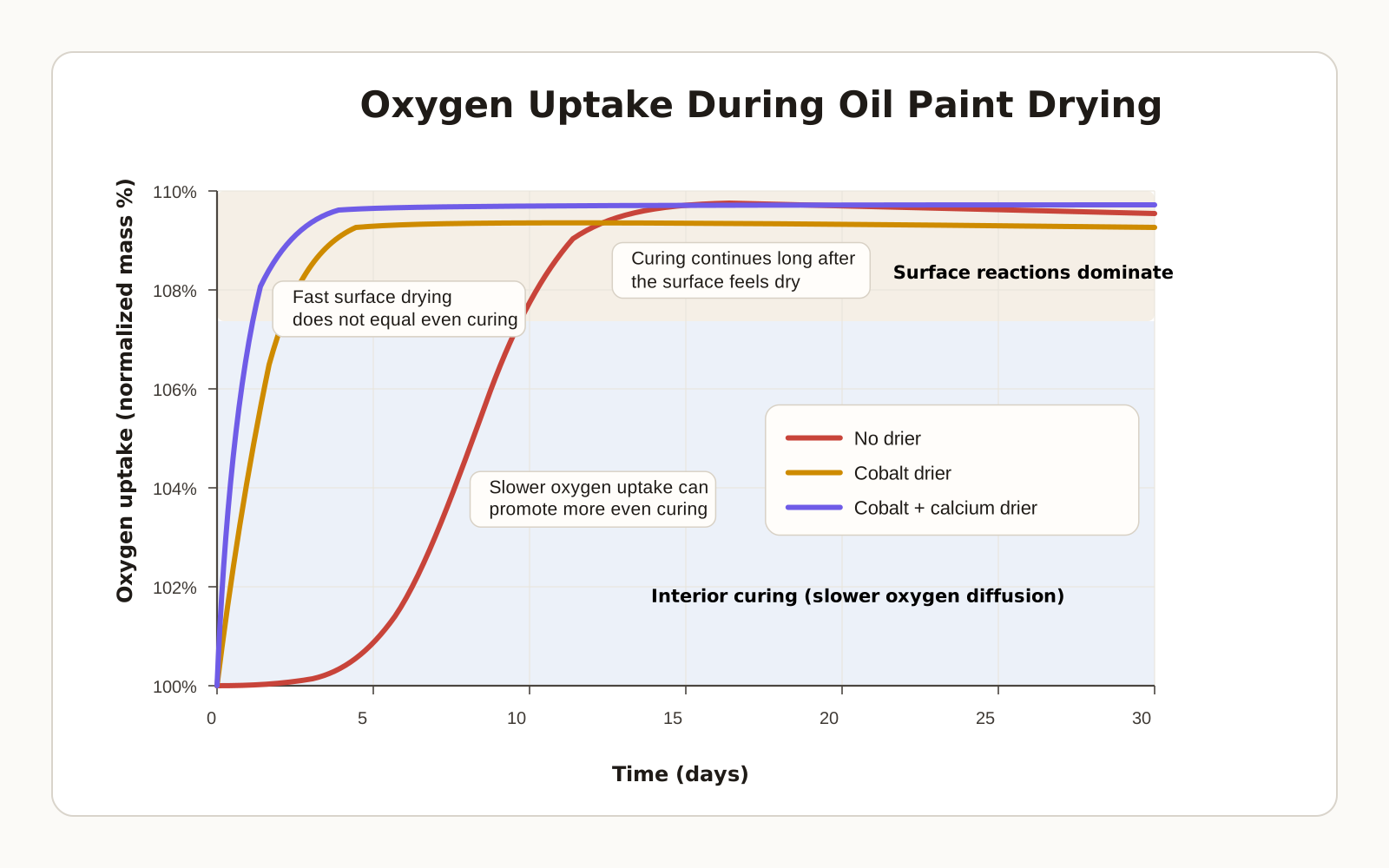
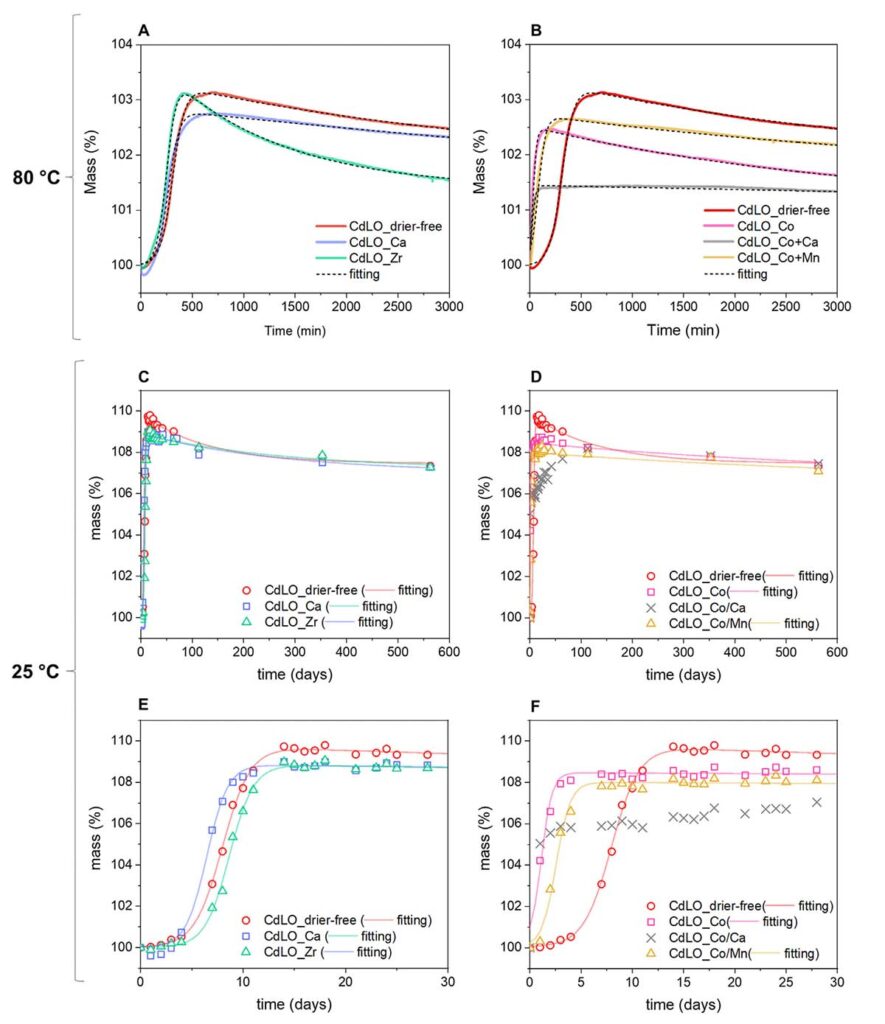
Figure 1. Simplified oxygen uptake during oil paint drying with and without driers. Cobalt-containing driers accelerate early oxygen absorption, producing rapid surface drying, while drier-free paint shows a slower, more gradual uptake. Although fast-rising curves indicate quicker surface reactions, they do not ensure uniform curing throughout the paint layer. All systems continue to absorb oxygen over time, demonstrating that curing persists well beyond the “dry-to-touch” stage. Slower oxygen uptake may promote more even polymer formation, whereas rapid early reactions can contribute to uneven internal structure. Adapted from data trends in Pizzimenti, Silvia, et al., Journal of Cultural Heritage 73 (2025): 465–475. https://doi.org/10.1016/j.culher.2025.04.026Figure 2. Oxygen uptake during oil paint curing with and without metal driers. Gravimetric curves show oxygen absorption over time for cadmium red oil paint films containing different drier systems. Top row (A–B): accelerated aging at 80 °C; middle row (C–D): natural aging at 25 °C and 50% RH over long durations; bottom row (E–F): early-stage curing (magnified). Cobalt-containing driers produce rapid initial oxygen uptake, indicating fast surface reactions, while drier-free systems react more slowly. Over time, all systems continue to absorb oxygen, demonstrating that curing persists well beyond the “dry-to-touch” stage. Differences in early reaction rates contribute to variations in film structure and uniformity. Source: Pizzimenti, Silvia, et al., “Impact of Selected Driers on the Curing Kinetics, Thermodynamics, and Molecular Features of Commercial Artists’ Oil Paints,” Journal of Cultural Heritage 73 (2025): 465–475. https://doi.org/10.1016/j.culher.2025.04.026
How Oil Paint Driers Influence Drying and Curing
Artists often use the word “drying” as though oil paint behaves like watercolour or acrylic: the liquid part evaporates, and the paint becomes solid. Oil paint does not work that way. Although small amounts of volatile material may evaporate from a paint or medium, the principal hardening of a drying oil occurs through a chemical reaction with oxygen in the air. The oil is not simply losing solvent. It is being transformed into a cross-linked polymer network.
Want to read the full article and unlock all resources? Choose an option below:
Painting on wood panels? Learn how plywood, MDO, and HDO boards serve as durable supports. This guide covers stability, surface prep, pros & cons, and best practices for oil, acrylic, and tempera.
Explore how oil paint driers speed up drying times, the types available, and their long-term effects on paint durability. Learn to choose the best driers for your artwork.
Discover how barite (baryte or blanc fixe) has shaped oil painting from the 18th century to today. Learn its properties, uses, and hidden drawbacks—why it stabilizes paint but can cause brittleness or “chalking” when overused.
Fat over lean explained with PVC/CPVC. Learn how tube paint, solvents, and mediums change film strength, flexibility, and cracking risk in layered oil and alkyd painting.
Please note:
This action will also remove this member from your connections and send a report to the site admin.
Please allow a few minutes for this process to complete.
Report
You have already reported this .
Subscribe to Our Newsletter
To begin reading the content, join thousands of artists enjoying our articles. Subscribe to receive updates on artists materials and practices.


Responses