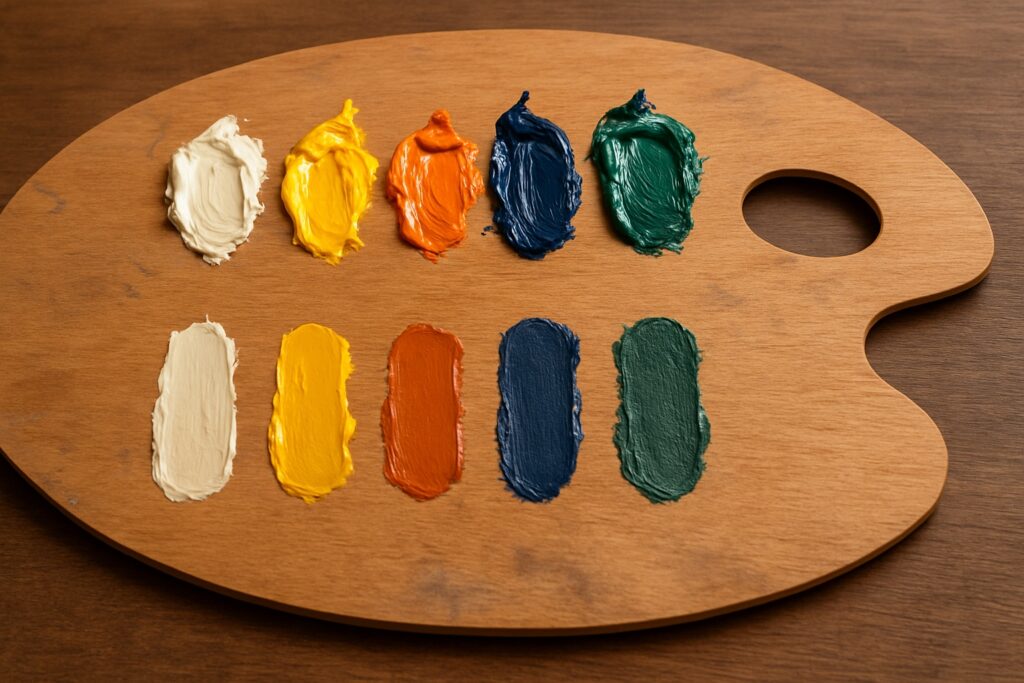
Fresh oil-paint tints rarely stay as bright as they appear on the palette—a phenomenon widely recognized as oil paint darkening, which compromises accurate value matching in subsequent layers. Many painters refer to this perplexing shift as “voodoo darkening,” while others call it “dry‑down darkening.” Conservation research indicates that the effect occurs while the paint film is still fluid, driven by two intertwined physical forces:
Pigment‑density packing (gravity‑assisted settling of denser particles).
Surface‑tension‑driven flow (Marangoni circulation within the wet layer).
When those forces are understood and kept in check, maintaining color consistency is far easier.
Oil Paint Darkening: What Painters Observe
When artists mix titanium white with high‑chroma colors, the wet tint usually matches the intended value. Within 24–72 hours, however, that same stroke can dry roughly half a value darker—even on relatively non‑absorbent grounds. This behavior is distinct from classic sinking‑in, which mutes gloss in dark passages; here, the gloss often remains, but the value itself drops. Instrument readings confirm a measurable decline in lightness (L*), while chemical analysis shows the pigment has not changed (Saranjam et al., 2016). A practical way to quantify the shift is to note the wet mixture’s Munsell (or NCS) notation and then compare it with a dry reference chip.
Why Light Tints Are More Vulnerable
Because light tints are dominated by white pigment, even a slight reduction in light scattering at the surface can cause them to appear noticeably darker. At the same time, the hue remains essentially the same. In deep passages—umbers, blacks, and other low‑value mixtures—the same redistribution is masked because most incident light is already being absorbed.
Oil Paint Darkening and Pigment‑Density Packing
Figure 1. Pigment Density Packing in Drying Paint: Heavier pigments sink toward the substrate while lighter pigments rise, leading to density-driven stratification and surface darkening in drying oil paint films.
Density Governs Movement
Pigments vary greatly in density: phthalocyanine green is approximately 1.7 g/cm³, titanium dioxide is 4.2 g/cm³, and basic lead carbonate (lead white) is 6.5 g/cm³ (DeLanoy, 2021). While the paint is fluid, heavier particles tend to sink, and lighter ones rise. The balance between this convective settling and random Brownian diffusion is described by the Péclet number (Pe). Diffusion dominates at low Pe, maintaining a uniform mixture. Once Pe increases to the tens to low hundreds for 5–20 µm particles in 60–100 µm oil films, gravity prevails, and the layer stratifies (Schulz & Keddie, 2018).
Convective settling is the bulk downward drift of dense particles under gravity, driven by differences in weight between pigments and the oil medium. Brownian diffusion is the random, thermally driven jostling of particles in all directions. When the paint is freshly fluid and its viscosity is still low, these two motions compete: diffusion tries to keep pigments evenly dispersed while settling pulls the heavier ones downward.
Want to read the full article and unlock all resources? Choose an option below:
Painting on wood panels? Learn how plywood, MDO, and HDO boards serve as durable supports. This guide covers stability, surface prep, pros & cons, and best practices for oil, acrylic, and tempera.
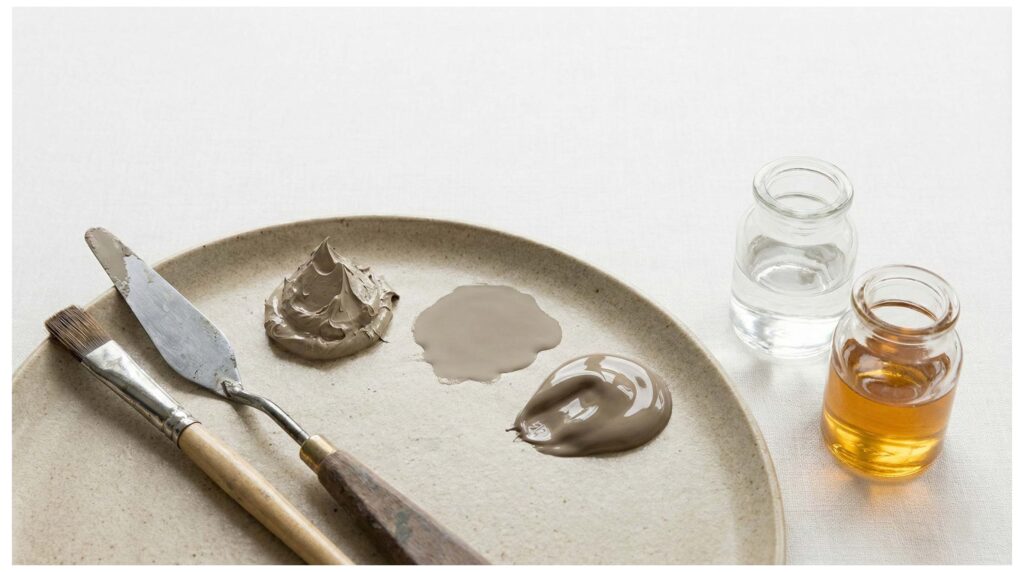
Fat over lean explained with PVC/CPVC. Learn how tube paint, solvents, and mediums change film strength, flexibility, and cracking risk in layered oil and alkyd painting.
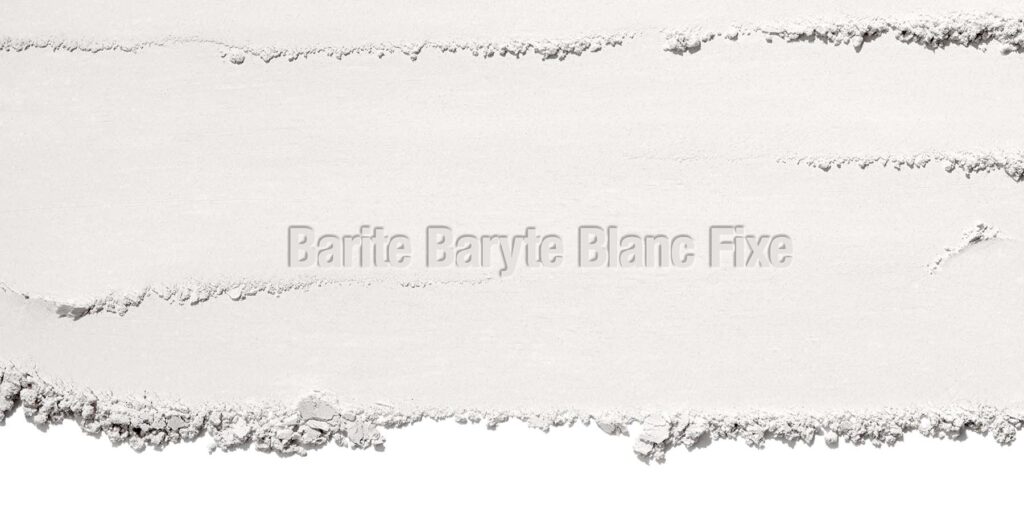
Discover how barite (baryte or blanc fixe) has shaped oil painting from the 18th century to today. Learn its properties, uses, and hidden drawbacks—why it stabilizes paint but can cause brittleness or “chalking” when overused.
Please note:
This action will also remove this member from your connections and send a report to the site admin.
Please allow a few minutes for this process to complete.
Report
You have already reported this .
Subscribe to Our Newsletter
To begin reading the content, join thousands of artists enjoying our articles. Subscribe to receive updates on artists materials and practices.





Responses