Oil painting, a revered medium in the art world, owes much of its durability and aesthetic appeal to the complex chemistry of oil paints. At the heart of this complexity is the oil itself, primarily composed of glycerol esters of unsaturated fatty acids. These oils undergo a fascinating transformation when exposed to air, a process that significantly impacts the mechanical and physical properties of the resulting paint films. For artists, understanding these changes is crucial, not only for mastering the medium but also for ensuring the longevity of their creations.
The Process of Drying and Oxidation
When oil paint is applied to a canvas, it doesn’t simply dry by evaporation as water-based paints do. Instead, it undergoes a process known as autoxidation. This reaction involves the oil reacting with oxygen in the air, leading to a series of chemical events: the formation of hydroperoxides, their decomposition, and the eventual crosslinking of molecules to form a solid polymer gel. This gel is what constitutes the dry paint film. Initially, oxygen uptake increases the weight of the oil due to the formation of hydroperoxides. However, as oxidation progresses, volatile compounds such as carbon dioxide and various organic molecules are produced and lost to the atmosphere, resulting in a net loss of weight.
The Influence of Oil Types
Artists have a range of oils to choose from, each with distinct fatty acid compositions affecting their drying times and film properties. Linseed oil, derived from the seeds of the flax plant, is favored in oil paints for its optimal balance of drying speed and film durability. It contains a high proportion of linolenic acid, which is highly reactive and forms a robust polymer network upon oxidation. This network is essential for creating a stable paint film that is less prone to cracking over time.
In contrast, oils such as safflower, walnut, poppy, and sunflower, which artists sometimes use to reduce the yellowing effect in lighter colors, have lower levels of linolenic acid and higher levels of oleic and linoleic acids. These compositions lead to softer, less durable films that may not withstand the test of time as well as linseed oil-based paints. The study highlighted that oils with a lower linoleic acid content, such as linseed oil, undergo less dramatic weight loss upon oxidation, indicating a more stable and durable film.
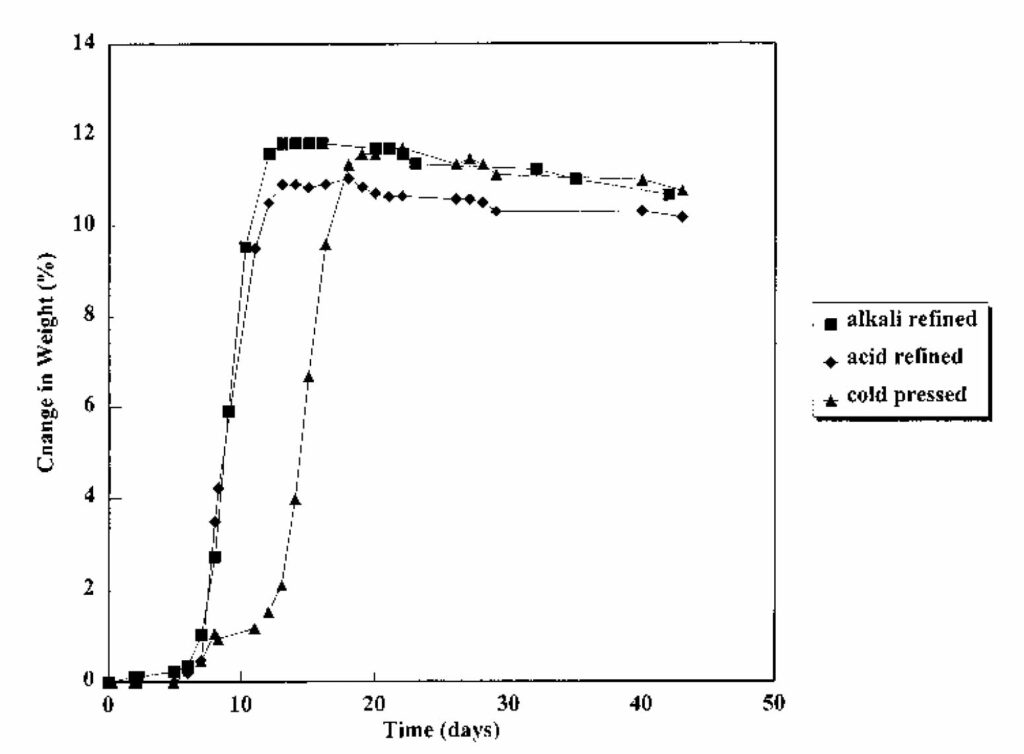
Changes in weight over 45 days of three linseed oil films: unprocessed cold-pressed linseed oil, acid, and alkali refined oils. The change in weight represents the rapid absorption of oxygen during the initial phases of oxidation. Alklai and then acid-refined linseed oils dry faster than cold-pressed oil due to the presence of antioxidants in the latter.
Oil Type
Oleic Acid (%)
Linoleic Acid (%)
Linolenic Acid (%)
Linseed
18
14
58
Hemp
12
58
20
Poppy
20
70
0
Walnut
28
60
12
Safflower
13
75
0
Sunflower
19
68
0
The Role of Processing and Antioxidants
The processing of oil can significantly impact the onset of drying and the overall behavior of the paint film. Oils can be cold-pressed, alkali-refined, or acid-refined, with each process affecting the presence of natural antioxidants that delay oxidation. Cold-pressed oils containing these antioxidants exhibit a delayed start in weight gain (oxygen uptake) but eventually reach similar levels of weight increase as their refined counterparts. This delay can be beneficial, allowing artists more working time, but it also underscores the importance of understanding the specific characteristics of the oil used.
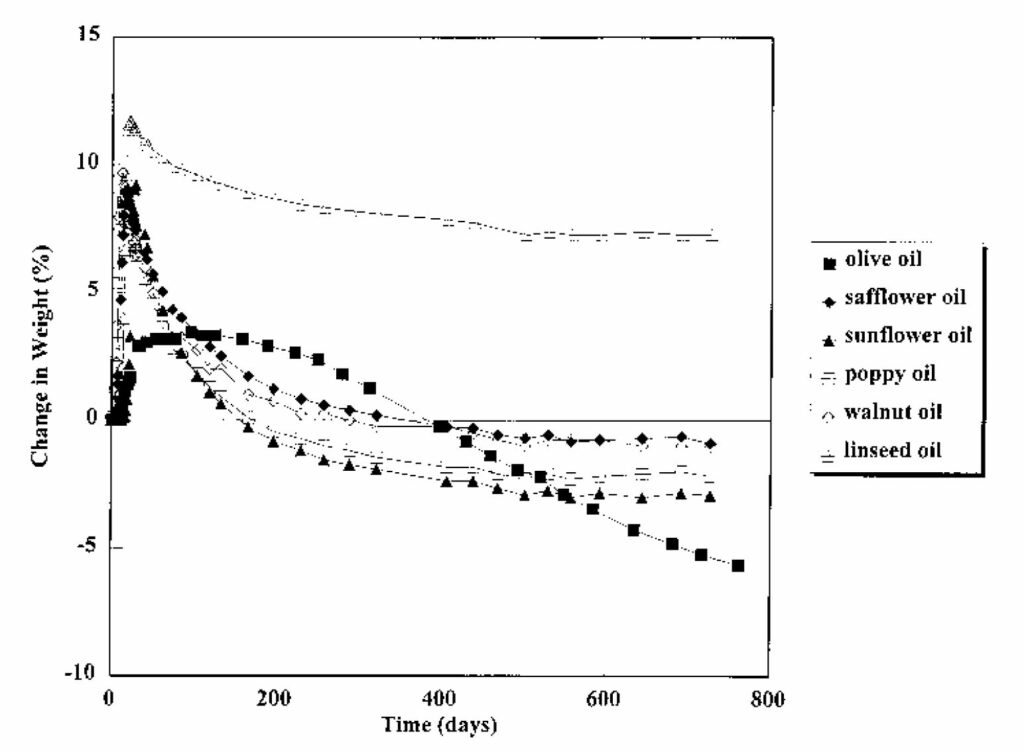
Changes in weight over 700 days of five oil films compared to cold-pressed linseed oil.
The graph shows olive oil (considered to be a ‘non-drying oil’) behaves differently from other commonly used ‘drying’ oils in painting. Olive oil’s oxidation journey starts with a moderate weight gain due to oxygen uptake but eventually leads to a significant weight loss, nearly eight percent from its peak, without undergoing polymerization or gel formation. This contrasts with other drying oils, such as linseed oil, which experience an initial weight increase of at least 8.5 percent, followed by a decrease after forming a solid polymer gel. The chemical structure of olive oil, rich in oleic acid and with minimal linoleic acid, differs markedly from oils like poppy, walnut, safflower, and sunflower, which contain higher levels of linoleic and oleic acids and scant linolenic acid. Linolenic acid’s presence in linseed oil, notable for its multiple carbon-carbon double bonds, facilitates polymerization through crosslinking, thereby limiting the creation of volatile compounds that contribute to weight loss. This results in linseed oil having a lesser degree of weight reduction post-oxidation compared to oils with lower linolenic acid content, highlighting the unique stability and drying characteristics of different oil types in artistic applications.
Want to read the full article and unlock all resources? Choose an option below:
Explore the process of paint film formation. This article demystifies the science behind the drying and film formation of artists’ acrylic and oil paints, offering insights into materials, techniques, and best practices for creating enduring artworks.
Learn how 19th-century treatments of linseed oil paint, including washing, heating, and lead-based driers, affect pigment wetting, drying rates, and long-term durability of oil paintings.
Explore how oil paint driers speed up drying times, the types available, and their long-term effects on paint durability. Learn to choose the best driers for your artwork.
Immerse into the epic sandbox of EVE Online. Find your fleet today. Trade alongside thousands of explorers worldwide. [url=https://www.eveonline.com/signup?invc=46758c20-63e3-4816-aa0e-f91cff26ade4]Begin your journey[/url]
Report
There was a problem reporting this post.
Block Member?
Please confirm you want to block this member.
You will no longer be able to:
See blocked member's posts
Mention this member in posts
Invite this member to groups
Message this member
Add this member as a connection
Please note:
This action will also remove this member from your connections and send a report to the site admin.
Please allow a few minutes for this process to complete.
Report
You have already reported this .
Subscribe to Our Newsletter
To begin reading the content, join thousands of artists enjoying our articles. Subscribe to receive updates on artists materials and practices.






This is fascinating. Would a chemically purer linolenic acid perform even better than linseed oil?
Immerse into the epic sandbox of EVE Online. Find your fleet today. Trade alongside thousands of explorers worldwide. [url=https://www.eveonline.com/signup?invc=46758c20-63e3-4816-aa0e-f91cff26ade4]Begin your journey[/url]