Understanding Canvas Preparation Techniques as a Composite System
A recent study published in Heritage Science by Janas et al. (2022) provides new insights into canvas preparation techniques and their impact on the mechanical behavior of painting supports. The research focuses on the role of animal glue sizing and chalk-glue ground layers in altering the response of canvas paintings to changes in relative humidity (RH). The findings are directly relevant to artists who use or contemplate historical methods of preparing their canvases.
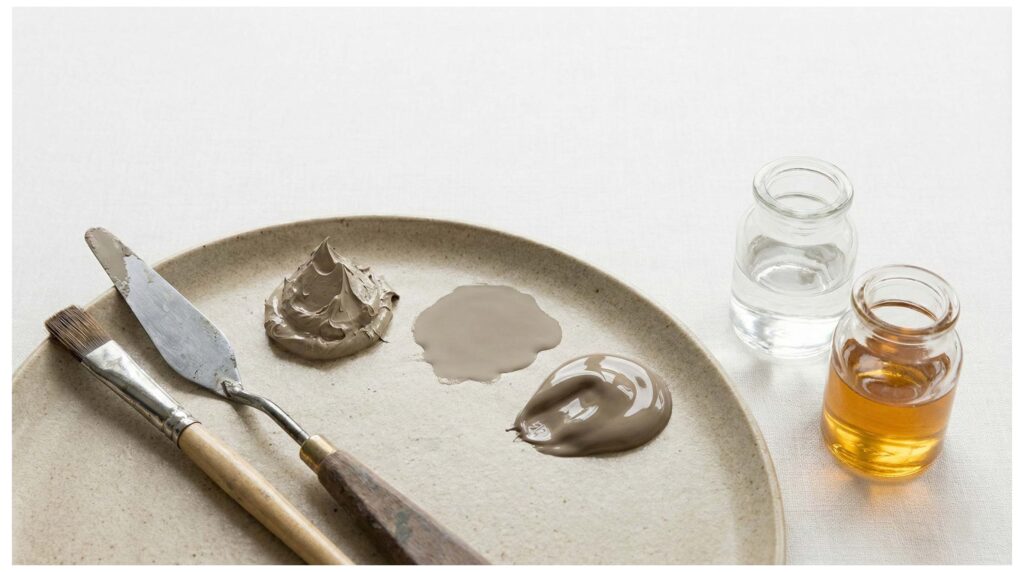
Traditionally prepared canvases consist of a textile substrate, typically linen, that is sized with animal glue. The glue serves as a barrier, isolating the canvas from the oil binder in paint, which can otherwise weaken or rot the fibers over time. Many artists also add a chalk-glue ground before applying paint. The research confirms what painters and conservators have long observed: these layers form a complex composite with mechanical and hygroscopic properties that differ significantly from raw canvas.
Glue Sizing Increases Stiffness but Retains Directionality
The study found that animal glue sizing substantially increases the stiffness of linen canvas. However, it does not erase the inherent anisotropy of the weave. The weft direction remains stiffer than the warp, and the bias (diagonal) direction continues to show the greatest flexibility. This means the mechanical behavior of the canvas still depends on the direction of the applied force.
Interestingly, the type of glue and the method of its application (warm liquid vs. cold gel) did not reliably predict the final mechanical properties of the sized canvas. Manual application, which varies in consistency and thoroughness, resulted in inhomogeneity across the canvas, with some areas more heavily impregnated than others. This irregularity introduces variability in stiffness and strain response across the painting surface.
For artists, this means that glue sizing—although it stiffens the support—can introduce unpredictable mechanical behavior unless it is applied with great care and consistency.
Chalk-Glue Grounds Alter Structural Behavior
When a chalk-glue ground is applied over the sized canvas, the composite becomes more mechanically uniform. Up to a certain point, strain affects the surface equally in all directions. However, the system becomes brittle. At a critical strain of approximately 0.002 (0.2% elongation), the ground layer cracks. Beyond this point, the canvas regains its anisotropic response.




Responses