
Forum Replies Created
-
BTW, that is a very beautiful icon! Brava!!
-
Hi Ann,
I once added alcohol to my egg oil emulsion. It definitely lasted much longer, but it curdled the emulsion over time. So no, I don’t add a preservative to my egg oil emulsion. It doesn’t last very long without a preservative – maybe a week (if refrigerated overnight). But I find it very fast and easy to make, in about 2 minutes, so I just make a fresh batch as needed.
It’s fine to paint oil over pure egg tempera or over egg oil emulsion paint. The only problem is that egg tempera paint films are porous (because they have “high PVC” – e.g. such a high ratio of pigment to binder that pigment particles just above the surface of the binder, which creates a microscopically rough, irregular, porous surface) – and, due to this surface, the oil binder isn’t as well exposed to the forces (light and air) that help it to cure, so the oil paint layers can take longer to cure; they may stay tacky for quite a while, in fact. So it’s important to either seal the egg tempera with a fast curing isolation layer (such as a very thinned shellac or B-72) – which has it’s own complicates – or work with very thin layers of oil, allowing them to dry fully before moving onto the next layer. After a few layers the rough, porous surface of ET gets filled in, the image becomes more evenly saturated, and the oil layers dry more readily. I hope that makes sense.
I’m a gold leaf dabbler, so I’m afraid I can’t offer you much help with that.
Happy painting, Koo
-
Hi Ann,
I agree with George about vinegar and mastic – neither are necessary nor good.
I make a simple egg oil emulsion by measuring an egg yolk (one yolk usually equates to one tablespoon). Then, in a small bowl and using a mini whisk, I gradually add (drizzle in) slightly less than one tablespoon of a drying oil (I prefer sun thickened linseed myself), whisking the two ingredients together. It’s the exact same process as making mayonnaise or hollandaise sauce (although no heat!). You end up with a deliciously rich medium you’ll be tempted to eat, but don’t – it’s for painting.
You can add water to the egg/oil combo to thin it (as one adds water to a pure yolk medium) but it’s not necessary; unlike a pure yolk medium – which is mucilaginous (yes, that’s a word!), doesn’t paint out well & dries too fast without added water in the medium – an oil + yolk medium makes a paint that brushes out nicely. (However, once you’ve tempered pigment and egg/oil medium, you can add water to that paint as needed, to achieve whatever consistency you want.)
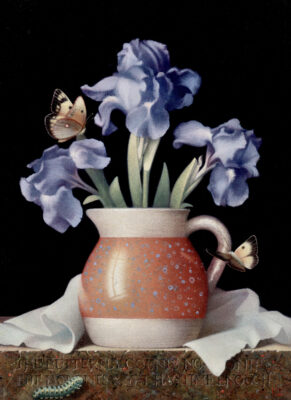
Add the egg/oil medium to pigments the same as you would combine pigments with a pure yolk medium. As long as there is more yolk than oil in the medium, it’s water soluble. It behaves more or less like egg tempera, but (1) has more plasticity (for example, if you try to “etch” into a dry paint layer with a sharp tool, e.g. to make fine lines, the paint is likely to tear rather than leave behind a crisp line); and (2) dries just a little more slowly, almost imperceptibly so, and (3) is a little more apt to lift if you too aggressively work an area. Values and colors are a bit more saturated; for example, I used this recipe to paint the still-life below because I wanted the black to be richer than in pure egg tempera.
If you add more oil than water to the medium, it’s a solvent soluble paint and behaves more like oil, albeit with a bit more crisp, linear potential to the paint.
The idea of adding a resin to the paint comes, I believe, from “modern” painters wanting to emulate the enamel like quality of some Northern Renaissance artwork. George knows much more about this than I – listen to him more than to me – but from the 18th up to 20th c. many people have been trying to figure out how Van Eyck did what he did, and consequently “inventing” various recipes based *not* on historical evidence but rather, shall we say, wishful thinking (there’s even a whole field of research devoted to this topic, called “Van Eyckian Studies” – you can look it up).
In fact, my understanding is that Van Eyck’s paintings are largely pure oil paint + some small areas of slightly modified oil paint (such as oil with a bit of egg yolk added, perhaps to bring out more crisp linearity in a line – my speculation – or oil modified with chalk for more body in the paint. Again, George knows more…). What makes Northern Renaissance art so visually wonderful is a masterful understanding of oil paint combined with a masterful sense of visual organization and design – not resins in the paint. Although I do think the fact that most old oil paintings have been, at this point, varnished by someone (the artist, a conservator, a museum) adds to their saturation and enamel-like beauty – would you agree, George?
Hope that helps. Koo
PS. When posted, my note appears with all sorts of odd insertions of </font>. I tried to clean it up, but if they appear again, apologies – hope you can decipher my post!