
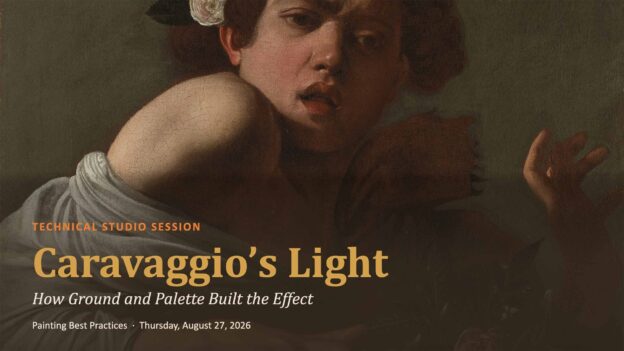
Caravaggio’s Light: How Ground and Palette Built The Effect
Technical Studio Session · August 27, 2026
Every painter who has tried to reproduce Caravaggio’s darkness by darkening their shadows and brightening their highlights has ended up with something heavy-handed and muddy instead of luminous. This session explains why that approach fails — and what specific, material decisions actually produced the effect.
Caravaggio’s chiaroscuro is often treated as a private gift, a lost medium, or a secret optical device. Conservation science tells a more useful story: cross-sections, X-radiographs, and infrared imaging of three Caravaggio paintings spanning his working life — examined together in the National Gallery’s 1998 technical study — show a mechanism built from a specific ground and a specific, disciplined palette, and show that mechanism changing, traceably, as his career and circumstances changed. This session works through what the technical evidence actually documents, painting by painting, what remains genuinely unsettled among conservators, and how the historical record has itself been revised as newer imaging arrived — held to the same conservation-science standard as the rest of the Technical Studio Session series, not rules of thumb or “old masters’ secrets.”
In this session:
- What conservation cross-sections actually show about Caravaggio’s ground — a single, oil-bound mestica of chalk and earth pigment, not a traditional gesso ground or a plain lead-white one
- The four different things Caravaggio did with that same ground across three National Gallery paintings — exposed, veiled, painted over, and, in one case late in his career, faked afterward in paint
- Why opacity, not value, is the actual lever behind the contrast — and why darkening the darks and brightening the lights fails to reproduce it
- What the palette behind the effect actually contained, and how it connects directly to the earth-and-lead-white palette from July’s Earth Pigments Masterclass
- How the mechanism changed, traceably, across roughly fifteen years of Caravaggio’s working life — and what the technical evidence can and can’t settle about why
- What newer imaging has revealed about the long-standing claim that Caravaggio never used preparatory drawings, and what that finding does and doesn’t mean
Recorded live August 27, 2026. Members have access to the session recording, a one-page studio handout, and access to the Painting Best Practices community for follow-up questions.
$35 · Free to Artisan members
Course Content
Course Includes
- 1 Lesson